What Are Citations in SEO?
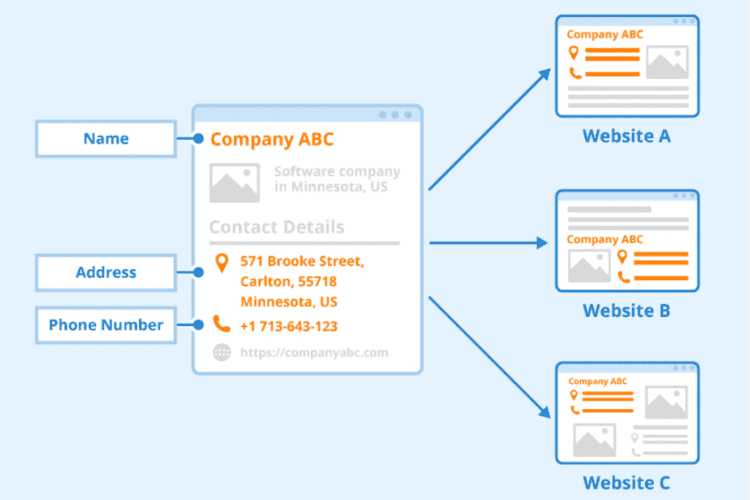
Local citations are online mentions of a business’s name, address, and phone (NAP), often in directories and business listings. These NAP (or NAPW with website) references serve as trust signals to Google about a business’s existence and location.
Citations remain highly influential: BrightLocal reports they are the 6th most important factor in Local Pack rankings.
In fact, nearly one-third of local-intent search results are directory listings. Well-maintained citations make a business easier to find online and strengthen credibility with search engines.
In short, accurate citations help improve local search visibility and drive more customer traffic.
The role of citations in local SEO
Citations help Google verify a business’s details and improve local relevance. Consistent citations across authoritative sites (e.g. Google, Yelp, Bing, Facebook) signal legitimacy.
BrightLocal found that directory sites account for ~31% of local search results, so being listed there boosts exposure.
Citations also indirectly aid SEO by attracting backlinks and referral traffic. For example, Yelp alone contributes heavily to AI and LLM search data.
In practice, a clean citation profile often correlates with higher rankings: one study showed 80% more Google visibility with listings on 10+ accurate sites.
Structured vs unstructured citations
Citations come in two flavors. Structured citations are formal directory listings (e.g. Yelp, YellowPages, Google Business Profile) that clearly show your NAP. Unstructured citations are informal mentions of your NAP on blogs, news sites, social posts, or anywhere not in a directory.
Both count as citations, but structured listings are easier to manage and more immediately visible in search results. Structured citations on niche or industry directories often carry extra authority.
However, unstructured mentions (like a local blogger quoting your address) are gaining importance too, as Google increasingly pulls information from social and news sources.
Why consistency matters?
Consistent NAP data across all citations is critical. Search Engine Land emphasizes that inconsistent listings can hurt rankings: “If any of your information is inconsistent, it can hurt your rankings and create a poor user experience”.
In practice, 70–80% of consumers rely on accurate contact info when searching locally. As one analysis notes, “consistent and accurate citations “directly correlate with improved visibility in maps and local results.
Inconsistent addresses or phone numbers confuse Google and customers alike, leading to missed calls and lost traffic. For example, Kumon (a 650-location franchise) manually cleaned all listings and saw a 63% jump in #1 Google rankings thanks to accurate data.
What Are Manual Citations?
Manual citation building means personally submitting or claiming each directory listing one by one. A person (or agency) visits a directory website, creates an account, and enters the business NAP and details by hand.
They then verify ownership (often by email or phone) before the listing goes live. Manual submissions give total control over every entry: you choose sites, tailor descriptions, and ensure each listing is exactly right.
Agencies or business owners often track this process in spreadsheets to keep an inventory of all citations. The effort is labour-intensive but precise. (By contrast, automated tools and data aggregators push your data to many sites via platforms.)
How does manual citation building work?
In a manual campaign, each directory is handled individually. First, you identify relevant sites (local chambers, niche directories, Facebook, etc.). Then you search to see if a listing exists.
If not, you create one; if it exists, you claim or edit it. You typically fill in business name, address, phone, website, hours, services, categories, and a unique description. Every submission often requires a separate login and may involve email/phone verification.
For example, BrightLocal notes that submitting one citation takes about 10 minutes on average, so 50 listings would require roughly 8.3 hours of work. This hands-on approach lets you tailor each listing but requires careful tracking of all logins and statuses.
Pros of manual citations
- Higher accuracy and control: Manually handling each listing minimizes mistakes. You ensure NAP is correctly formatted on every site. In fact, 86% of local SEO experts say quality of citations trumps sheer quantity. Customizing descriptions and categories for each directory (especially niche ones) boosts relevance.
- Target niche/local directories: You can hand-pick the most relevant platforms for your industry and area. For example, lawyers can list on Avvo/Justia, restaurants on local food guides, etc. As one survey shows, 33% of experts rate niche directories as the highest authority. Manual building ensures you don’t miss specialized or fee-based sites.
- Consistency assurance: Since you’re submitting data directly, it’s easier to maintain consistent NAPW across all sites. Direct oversight “ensures your information remains consistent and accurate”. If there are name variations or branding nuances, you can apply them carefully to avoid confusion.
Cons of manual citations
- Time-consuming: Manual submission is slow. Even at 10 minutes per listing, covering dozens of directories adds up. Keeping track of hundreds of sites (and updating them when details change) can monopolize staff hours. This labour-intensive process can divert time from other marketing tasks.
- Prone to human error at scale: Managing many manual entries risks typos and copy-paste mistakes. One guide warns that “copy-paste mistakes happen” and wrong digits or formatting can slip into multiple listings. Each error erodes credibility and may cost customers (wrong phone numbers, etc.).
- Hard to scale: For a single location, manual work is feasible; for multi-location businesses, it multiplies. Each new branch needs new entries, effectively repeating hours of work. Without dedicated staff or outsourcing, expansion is slow.
What Are Automated Citations?
Automated citation building uses software, platforms, or data aggregators to distribute your business data widely. Instead of entering details on each site, you feed your NAPW into a tool or service (like Moz Local, Yext, BrightLocal, Whitespark, etc.), and it pushes that data to many listings at once.
Data aggregators (e.g. Infogroup, Acxiom) collect information from businesses and supply it to hundreds of sites. Listing management software syncs your info across partner directories and can claim listings for you.
In short, automated solutions save time by handling bulk citation tasks. You update your info in one place, and the system distributes it widely.
With automation, you typically create one master record. You enter your name, address, phone, website, and other details into the tool’s dashboard. The software then submits or syndicates this data to various aggregators and directories via APIs or data feeds.
For example, a platform might submit to major data aggregators, which then pass info to Google, Apple Maps, Uber, etc. Some tools (like Yext) offer a curated list of high-authority sites and let you choose which to activate.
Others simply attempt “global” distribution. After initial setup, any change you make in the tool can be pushed out to all linked listings at once. The key point: automated tools handle citations in bulk, with little manual input site-by-site.
Pros of automated citations
- Faster and scalable: Bulk submissions are much quicker. Law firms using automated citation tools achieve 73% faster directory coverage than doing it manually. A single change (e.g. new phone number) can be pushed to hundreds of listings simultaneously. This speed is crucial for businesses opening new locations or rapidly expanding.
- Easier updates and maintenance: When your info changes (address, hours, etc.), one update in the platform triggers updates everywhere. This keeps data synchronized with minimal effort. Tools often include monitoring, so you can see in one dashboard if a listing is inconsistent or needs attention.
- Time and cost savings at scale: Automated platforms can save huge labor costs. For instance, one SEO agency reported cutting citation build time from 5 minutes per listing to 5 minutes per campaign, saving ~$167,500 annually for 500 clients. Such efficiency helps agencies and multi-location brands manage citations profitably.
Cons of automated citations
- Potential for inaccuracy or formatting errors: Relying on feeds can introduce quirks. In some cases, aggregators have “mangled” data – shortening business names, transposing phone digits, or misformatting addresses. These errors can slip into many listings at once, making them harder to spot.
- Limited coverage of niche sources: Automated tools may focus on major or paid directories and miss smaller local or industry-specific sites. You might need to manually submit to certain sites anyway. For example, many aggregators don’t handle Google Business Profile, Facebook, or specialized directories; these often require direct manual listing.
- Ongoing costs and dependency: Automated services typically charge annual subscriptions (e.g. Moz, Yext, Whitespark). In Jasmine Directory’s analysis, a single location can cost £99–150/year for major aggregators. If you cancel, your data feed stops: some listings will no longer receive updates, and some may even be removed. This recurring cost can add up for businesses with many locations.
Manual vs Automated Citations: Side-by-Side Comparison
To decide the best approach, consider key factors:
Cost: Manual citation building has little upfront cost besides labor. Hiring a freelancer to submit to 30–50 sites might cost £900–1,800, but it's largely one-time.
Automated tools charge ongoing fees (e.g. £120/year for BrightLocal’s aggregator feeds, or £500–1,000 for Yext).
Over five years, simple manual submissions (£2,000) and a hybrid approach (~£1,750 including £750 in service fees) had similar totals. Multi-location adds fees linearly (e.g. 10 sites becomes 10× annual fee).
Accuracy: Manual allows meticulous entry, minimizing errors. However, human error can creep in – one expert notes that copy-paste mistakes or typos in even a few listings can cost customer calls.
Automated feeds risk formatting errors en masse (e.g. phone transpositions). Both require quality checks: manual requires double-checking each listing; automated demands verifying that the tool’s output is clean.
Scalability: Automated clearly wins at scale. Agencies report 73% faster coverage with automation, and tools can handle hundreds of listings without exponentially more work. Manual methods slow dramatically with volume (50 sites is 8+ hours; 200 sites is four times that). For a growing business, automated systems can quickly replicate listings to new locations.
Control: Manual submissions give you total control per site (which image, category, description). You can ensure brand messaging is perfect.
Automated methods trade off some control for speed: they may not let you customize individual entries as deeply. If you need fine-tuned listings (e.g. long-tail categories, unique photos), manual might be preferable.
Maintenance: If your NAP rarely changes, manual might be acceptable (just update when needed). If your business info changes often (rebranding, moves), automation eases the update burden.
However, automation requires a subscription: if you stop paying, maintaining citations becomes manual again. Jasmine Directory notes that aggregator subscriptions must be renewed to keep pushing updates. Manual updates, while tedious, incur no recurring fees beyond labor.
When Manual Citations Make Sense?
Manual methods are best for niche or hyper-local focus. If your business depends on very specific directories (legal, medical, industry groups, local newspapers, etc.), targeted manual submissions ensure presence in those key places.
For example, law firms often prioritize Avvo or Justia, and restaurants target local food guides – these often require manual listing. Industries known to change details frequently (e.g., pop-up stores, seasonal businesses) may find one-off manual updates more cost-effective than paying a yearly fee.
Manually building citations also suits small or single-location businesses on a tight budget – you can do a handful of listings yourself with minimal expense.
Case in point: Kumon, with 650 locations, manually cleaned and updated all key UK directories and achieved a 63% increase in #1 rankings. This shows that even large networks can benefit from a high-touch approach when accuracy is paramount.
When Automated Citations Are the Better Fit?
Automation is ideal for multi-location businesses or agencies managing many clients. A platform can rapidly push updates to dozens or hundreds of listings, which is impractical to do manually.
Companies that need a fast rollout (e.g., national chains opening new branches) benefit immensely: automated tools reach comprehensive directory coverage much faster. It also makes updates simple – one dashboard change updates all stores.
If you have stable NAP data and want to ensure a broad presence in major listings (Google, Bing, Yelp, Apple Maps, etc.), automated services are efficient. However, be aware that you might still supplement with manual listings for any sites the software misses.
Can You Combine Both Approaches?
Yes. A hybrid strategy often yields the best results. You can use automated tools for broad distribution and then manually handle any gaps. For example, push your info via aggregators to the top general directories, while manually submitting to hyper-local or industry sites that aren’t covered.
Jasmine Directory advises using automation for “broad, low-priority directories” and manual efforts for “high-value directories where you need precision”.
Also, periodically audit automated listings to catch errors and correct them by hand. In practice, many businesses automate 80% of their citations (for efficiency) and allocate some manual labor to the remaining 20% (for control). This blend can cut costs and time while ensuring accuracy.
Case Study: BrightLocal reports one agency saved 200 hours per month by using automated local SEO tools (including citation software). Meanwhile, the Kumon example shows a combined focus: they used a citation service (BrightLocal’s tool) to clean data across 650 centers, manually verifying key listings.
As Kumon’s CMO said, this hybrid effort of cleanup and targeted manual claims allowed them to “achieve what otherwise would have been a Titanic task,” resulting in dramatic ranking gains.
Conclusion
Building citations by hand or by software each has its merits. Manual citations offer pinpoint accuracy and niche reach but take significant time and labour. Automated tools provide speed, scale, and easy updates, but can introduce errors and recurring costs.
There is no one-size-fits-all answer: small local shops may do fine manually, while multi-location enterprises likely need automation.
Most businesses find a mix of both approaches works best – ensuring broad coverage quickly while carefully curating the most important listings. In all cases, focus on data accuracy and consistency.
A study of local SEO experts notes that accurate citations are considered “critical” for ranking. After all, it’s better to have 20 correct, consistent citations than 100 haphazard ones. In local SEO, trust and precision often matter more than speed alone.