Marketers often debate whether targeting local or national search terms drives better results. Remarkably, about 46% of Google searches have local intent, so optimizing for location-based keywords is crucial.
In this article, we compare local and national keyword strategies using recent data and case studies. By examining real stats – like studies showing an 80% conversion rate on local mobile searches – we’ll reveal which approach often wins in conversion for different business types.
What Are Local and National Keywords?
About 46% of Google searches seek local information. Local keywords explicitly include a place or “near me” (e.g., “coffee shop in Austin” or “divorce lawyer NYC”). They signal that the searcher wants services or products nearby.
In contrast, national keywords have no geographic marker (e.g, “best productivity tools,” “online project management software”) and target a broad audience.
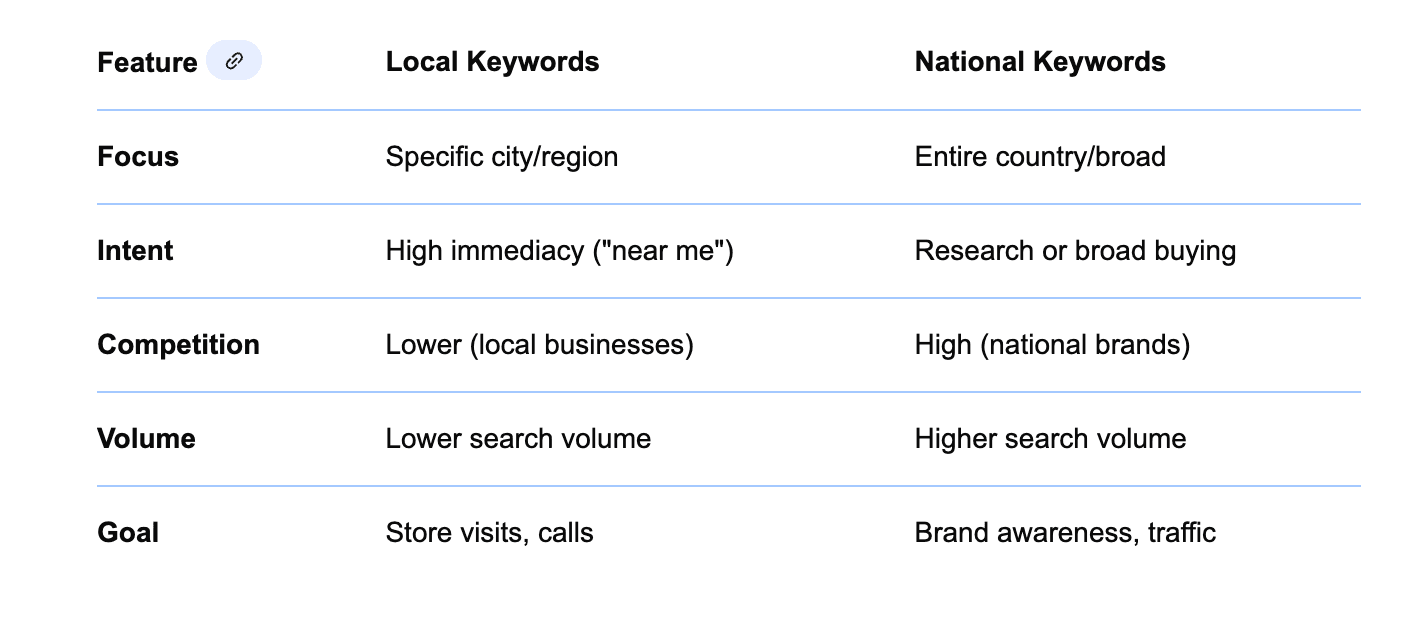
Understanding these terms is key: local queries often indicate immediate intent, whereas national terms tend to be more informational or brand-related.
Defining Local Keywords
Local keywords include city, region, or “near me” phrases, for example, “coffee shop in Austin” or “dentist NYC”. Businesses use them to capture nearby customers and high-intent traffic.
These queries often have a very high conversion rate: one study found that mobile searches for local businesses convert at about 80%, and 75% of those lead to an actual store visit. Mobile users frequently research local businesses: 63% use multiple devices to find local shops.
Google reports roughly 76% of smartphone searches for a nearby business result in an in-person visit within a day, underscoring immediate buying intent.
For example, a local plumber targeting “emergency plumber near me” only competes with other plumbers in the city, not the whole country. This approach “leads to more calls and more jobs”.
Examples:
- “coffee shop in Austin” – someone wanting a nearby cafe.
- “divorce lawyer NYC” – someone in Manhattan seeking legal help.
Defining National Keywords
National keywords are broader phrases without locations, like “best productivity tools” or “online project management software.” They aim at a nationwide (or global) audience. Big e-commerce sites and SaaS products use them to build mass reach.
Because these searches often represent earlier research (not an immediate need), conversion rates tend to be lower: average e-commerce conversion hovers around 2.9%. However, national SEO focuses on scale and trust.
High-quality content and backlinks build brand authority. In fact, leads from organic search convert at a 14.6% close rate, vastly higher than many outbound channels. Though slower, a successful national strategy can drive huge traffic and long-term revenue growth.
What is the Difference between Local and National Keywords?
The Real Question: What Do You Actually Want to Rank For?
Instead of thinking purely local vs national keywords, align keywords with your goals. Ask: Do my customers usually look for something nearby, or is my product/service used anywhere?
Local keywords bring urgent, transactional visitors; national keywords attract broader research-phase visitors.
Mapping your business model to search intent is crucial. For a local dentist, ranking for “dentist [city]” fits their needs. For a software company, ranking for “best [industry] software” makes sense.
Intent Behind Local vs National Searches
Local searches tend to be transactional; people are ready to act. Google/Nielsen data shows 55% of mobile searchers want to purchase within an hour (83% within a day). Similarly, up to 78% of local mobile searches end with an offline purchase.
In contrast, national keywords often imply informational intent. They capture people at earlier stages, so conversions come later. However, organic leads stay engaged: SEO-sourced leads have a 14.6% close rate (versus just 1.7% for outbound).
In short, local queries usually signal “near me, buy now”, while national queries are more like “research and compare.”
Conversion Potential by Business Type
- Local Service Businesses: Think plumbers, dentists, home contractors, etc. These rely on nearby clients who decide quickly. For example, targeting “emergency plumber near me” in Kansas City means outranking only local competitors and directly boosting calls.
In one case, a regional eye clinic launched local-focused SEO and saw procedures increase 33.5%, driving a 333% jump in revenue. These dramatic gains illustrate how strong local intent often translates into fast conversions.
- National E-commerce/SaaS Platforms: These brands sell across regions or online. They chase broad terms to attract traffic nationwide. Average conversion rates are modest (~2–3%) because they draw in large but varied audiences.
The payoff comes from volume and high-value customers. Notably, organic search leads generate roughly 5.7× higher lifetime value than paid leads. So, while immediate conversion is lower, each national SEO lead can be much more valuable over time.
Which Keywords Convert Better — And Why?
When it comes to conversion, local keywords often have the edge – especially for physical businesses.
- High Intent, Fast Decisions: Local queries indicate purchase-ready customers. Studies show mobile local searches convert at 80% (vs much lower for generic queries). Roughly 55% of mobile researchers buy within an hour, and 76% of local searches lead to a store visit within 24 hours.
- Map Pack Dominance: The top local listing grabs a huge share of attention. About 35% of clicks go to the #1 spot in Google’s local 3-pack. In fact, the local pack attracts around 44% of all local search clicks. Ignoring these location-based features means missing nearly half of potential clicks. Plus, “near me” terms boost conversions: e.g., searches like “boutique near me” drove 150% more conversions than generic searches.
- Case Example – Local Focus: One business targeting local keywords saw dramatic results. A Kansas City clinic optimized for local services and jumped 33.5% in monthly procedures, yielding a 333% revenue surge. This shows local terms often deliver direct ROI for brick-and-mortar stores.
By contrast, national keywords shine when your brand can capture a much larger market:
- Mass Reach, Lower Instant Conv.: National terms have much higher search volume but weaker immediate intent. E-commerce sites see ~2.9% average conversion. You need scale: ranking for broad keywords can bring thousands of visitors, but few buy on the first visit.
- Trust and Long-Term Gains: National SEO builds authority. Organic search leads close at a ~14.6% rate, thanks to intent and trust. Over time, strong national SEO often doubles or triples site traffic.
For example, companies with powerful backlink profiles have seen 200%+ traffic growth over ~2 years. And each national lead is worth more: organic leads can yield ~5.7× more lifetime revenue than paid ads.
Common Mistakes That Kill Conversion
Avoid these pitfalls when choosing keywords:
- Going Broad Too Soon: Local businesses that target national keywords prematurely waste budget. Remember, 46% of searches are local. If you serve a neighborhood, skipping local SEO means losing out on customers who intend to buy now. Always secure local visibility first.
- Ignoring Local Profiles/Landing Pages: Not optimizing Google Business or local pages means missing huge traffic. The local 3-pack alone commands ~44% of local search clicks.
If your GMB profile or “near me” landing pages are incomplete, you surrender those clicks. For example, optimizing your profile can raise visibility by 70%, so neglecting it hurts conversions.
- Neglecting Mobile UX: Over 60% of local searches are on smartphones. A non-responsive site or slow mobile page will kill conversion. Given 55% of mobile searchers want to buy within an hour, mobile optimization is mandatory. If your pages aren’t fast and user-friendly, impatient customers bounce.
- Chasing Vanity Keywords: High-volume generic terms (like “plumber”) may sound good, but they draw low-intent traffic. Instead, focus on actionable terms (“plumber open now,” “24/7 plumber [city]”). Studies show adding “near me” can boost conversion by 150%. Target exactly the phrases your high-value customers are using.
- Ignoring Follow-Up: Even after ranking, failing to follow up kills conversions. Organic leads are valuable, so nurture them quickly (within minutes). Data shows SEO leads close ~14.6%, but slow follow-up can squander that. Always pair your SEO with fast lead management for maximum conversion.
How to Choose the Right Keyword Focus?
Tailor your keyword strategy to your data and goals.
- Use Geo-Targeting Tools and Search Volume Wisely: Don’t just pick the highest-volume keywords; pick those with low volume with the right intent. Use tools like Google Keyword Planner or Ahrefs with location filters to find how often people search a term in your area.
Look for modifiers like city names or “near me” in high-intent phrases. For example, tools can reveal that “near me” versions of your services often have lower competition and much higher conversion. Always balance raw search volume with conversion signals.
- Consider the Buyer Journey: Map keywords to funnel stages. Local keywords usually align with bottom-of-funnel searches, so they should be used for immediate offers (e.g., service landing pages, phone calls, booking pages).
National keywords often fall in top/mid-funnel (research queries), so use them in educational blog content or webinars. For instance, a search for “divorce attorney in Dallas” is likely a lawyer booking, whereas “how to file for divorce” is research.
Ensure your landing pages and content match these intents. Also track metrics like calls or form fills per keyword.
Remember that inbound SEO leads have a 14.6% close rate; treat them with nurture campaigns to maximize conversions over time.
- SEO Strategy Examples for Both Approaches:
- Local-First Strategy (New Business): A new local cafe might focus exclusively on “city coffee shop” or “best cafe [city]” keywords, and optimize its Google Business Profile.
For example, PinMeTo case studies show that a cafe targeting “cafe + city” doubled foot traffic by ranking in local packs. Over a few months, they add neighborhood pages (like “downtown cafe”), driving steady visits and calls.
- National-First Strategy (Digital Product): A SaaS startup might target broader keywords like “top CRM software” or “best project management tool.” They invest in blog posts, guides, and backlinks.
This takes longer, but when they land on page 1, the brand visibility jumps. SEO leads then funnel into free trials or email lists.
As a rule of thumb, national campaigns often take 6–12 months to mature, but each new customer tends to have higher lifetime value (as shown by the 5.7× metric).
A mixed approach often works: e.g., the startup ranks for a few geographic hubs (like “crm software USA”) to pick up early leads while building long-tail content.
Conclusion: So… What Converts Better?
In summary, local keywords usually win on conversion rate, especially for brick-and-mortar and service businesses. They signal immediate intent – studies show most local searches lead to quick actions (78% lead to offline purchases, 76% result in store visits).
A focused local SEO effort can dramatically boost leads and revenue fast (as in the 333% case study).
National keywords convert at a lower rate (typical ecommerce ~2.9%) but reach far more people. They’re worth pursuing if you have the budget and patience for a longer sales funnel.
With strong content and branding, organic search can become a major sales channel (SEO leads close at ~14.6% and yield high lifetime value).
Final Advice: Align scope with your business stage and budget. New or single-location businesses should start hyper-local: target city or “near me” terms, optimize Google Business, and drive foot traffic.
Expand outward only once you’ve captured your home market. Conversely, large e-commerce or SaaS companies can afford to chase competitive national terms, building brand authority and scale.
In all cases, focus on keywords that match actual customer intent and measure conversions (calls, visits, signups), not just traffic. By choosing the right balance between local and national keywords, you ensure your SEO efforts directly drive real business results.