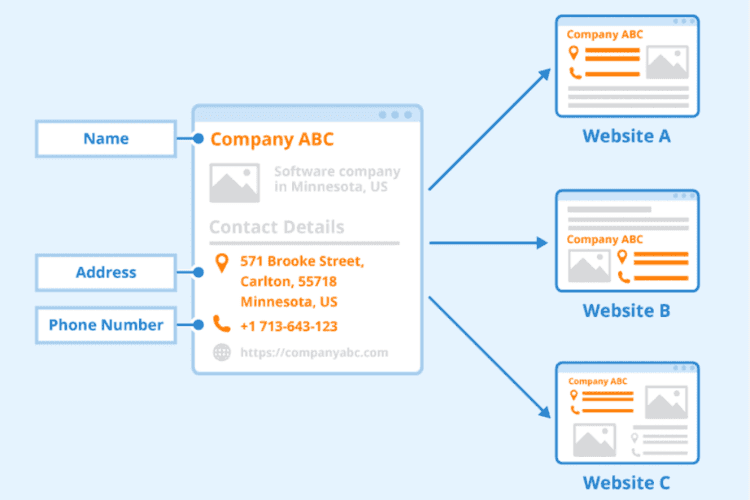
Local citations are online mentions of your business’s name, address, and phone (NAP) in directories and websites. They help consumers find you and signal credibility to search engines. In fact, 80% of U.S. consumers search for local businesses online weekly.
Consistent, accurate citations are crucial: 62% of people would avoid a business if they found incorrect information online. We’ll explain what local citations are, why they matter (backed by data), and exactly how to build them safely and effectively.
What Are Local Citations?
Basic Definition
A local citation is any online reference to your business’s NAP details. Structured citations appear in business directories (e.g., Yellow Pages, Chamber of Commerce listings) or on mapping platforms; unstructured citations are mentions in articles, blog posts, social media, etc. Both types carry your NAP.
For example, SEO pros define citations as “online listings of your business information (NAP)”. These listings boost discoverability. Top-ranked local businesses average about 81 citations each, showing the impact of having your info widely listed.
In short, structured (directory) and unstructured (mentions) citations together tell Google and users that you’re a real, active local business.
Real-World Examples
Well-known citation sources include:
- Google Business Profile (GBP) – The essential listing; 72% of consumers use Google to find local business info. Claiming your GBP profile (with accurate hours, photos, etc.) is foundational.
- Yelp – A major review site with about 178 million monthly users. Yelp citations (even without reviews) carry weight because many people check Yelp first.
- Facebook – Local business pages on Facebook act like mini-citations. About 49% of users consult Facebook for local info.
- Apple Maps & Bing Places – Often overlooked, but Apple Maps is used by ~16% of searchers, and Bing by ~14%. Ensuring your info is correct here covers more of your audience.
Each of these platforms lists your NAP (plus business category, hours, photos, etc.), making them core citation sources.
Why are Local Citations Important for Local SEO?
Influence on Local Pack Rankings
Local citations contribute directly to Google’s local ranking algorithms. Appearing in the “Local Pack” (the map listings) is vital: 42% of searchers click on Google’s map pack for local queries.
In ranking factor studies, citation signals account for roughly 6% of Local Pack rank weight. That may sound modest, but in competitive niches even a few percentage points can tip the balance.
For example, “GBP signals” are the top factor (32%), followed by reviews (20%), with citations at 6%. So building citations helps improve your prominence in local search and map results.
Trust Signals and Business Legitimacy
Consistent citations also build trust. For consumers, accurate listings are an important trust signal. In one survey, 80% of consumers said they lose trust in a local business if they see incorrect contact details or a name online.
Likewise, 62% would avoid a business altogether upon finding wrong info. Citations (especially on authoritative sites) signal that your business is real and up-to-date.
For example, 61% of consumers use business directories like Google or Yelp to vet new local businesses. Ensuring your citations are correct shows reliability, which not only helps your SEO but also keeps potential customers from bouncing to competitors.
Citations vs. Backlinks – Key Differences
Both citations and backlinks involve your business’s name appearing online, but they play different roles. Citations (business listings) primarily provide NAP consistency and relevance for local search.
Backlinks (links from other sites) confer authority and relevance for general SEO.
Recent local ranking surveys quantify this: in Local Pack factors, link signals carry ~8% weight, whereas citation signals carry ~6%. In the broader organic local ranking, links count for 24% versus 7% for citations.
In practice, that means citations help you show up locally by reinforcing your presence (think phone book entries), while backlinks boost your overall site authority. Both are important: citations build the foundation of trust and consistency, and backlinks build credibility in Google’s eyes.
Types of Local Citations
Core citations come from major directories and data networks. Data aggregators like Infogroup (Data Axle), Neustar Localeze, Factual, and Foursquare push your business data to hundreds of sites at once.
These in turn populate top directories (Google, Bing, Apple Maps, Yelp, TripAdvisor, etc.). For example, data aggregators feed Google Business Profile and many online yellow pages.
Making sure your information is submitted correctly to these aggregators (often via an automated submission) quickly establishes a base of consistent citations.
You should also directly claim listings on the biggest directories (Yelp, Bing Places, Apple Maps) and local city sites to reinforce your core presence.
Niche-Specific Citations
Industry-specific directories are tailored to certain businesses. For example, healthcare providers use Healthgrades or Vitals; lawyers use Avvo or FindLaw; restaurants use TripAdvisor or Zomato; home services use Angie’s List or Houzz.
These niche directories tend to have a motivated audience. Listings on credible, industry-focused sites boost relevance. For instance, a dentist with profiles on DentalCare.com or Healthgrades gets a citation plus a strong thematic context.
Even if you skip broad directories, missing niche opportunities can hurt. SEO experts note that being listed in trusted, industry-specific directories improves credibility and visibility more than having dozens of irrelevant listings.
Local/Geo-Specific Citations
Local citations target a geographic area. These include your city or state Chamber of Commerce, local business associations, or community portals. Example: a small-town bakery might have a listing in “Springfield Business Directory” or a county tourism site.
While fewer consumers use these, they show local relevancy. Google picks up on these hyper-local signals too. Check for any town or region-specific sites in your area (often .gov or .org sites) and ensure you have a presence.
Even local newspapers or event sites can serve as citations when they list your address.
Unstructured Citations (Mentions in Blogs, News, etc.)
Unstructured citations are informal mentions of your business name, address, or phone. For example, if a local blogger writes about “Bob’s Plumbing (210 Main St.)” without linking, that’s an unstructured citation.
Or a news article covering “Corner Cafe at 123 Elm St.” counts too. These citations are harder to track but can be powerful trust signals, especially if they include key info. They also reach audiences through word-of-mouth and journalism.
Whenever you see your NAP mentioned in the media or on local websites, consider it a citation. Encouraging mentions, for instance, by sponsoring local events or writing guest posts, can indirectly build citations, though structured listings should be the priority.
How to Build Local Citations Safely?
Start with NAP Consistency
Begin by standardizing your business name, address, and phone (NAP) format. Always use the same spelling and punctuation. For example, if your address is “123 Main Street, Suite 4,” don’t alternate between “St.” and “Street.”
Consistency is crucial: remember that 62% of customers will avoid a business with inconsistent info online. Publish your NAP the same way on your website, Google Business Profile, and any citation site.
Tip: Pick one address style (with or without “Suite”) and one phone format (with area code, with or without parentheses) and stick to it everywhere. Check existing listings with a citation tool (or manually) to find and fix any mismatches before building new listings.
Claim and Optimize Key Profiles
After NAP consistency, claim your high-impact profiles. This means securing your Google Business Profile, Bing Places, and Apple Maps listings if you have a storefront or service area.
Optimize each by filling out every field: business category, hours, website, photos, and a full description. A well-optimized GBP is especially critical; it’s often called the single most important GBP ranking factor.
According to industry research, “Google My Business is the top ranking factor for local queries.”
Also claim profiles on Facebook (as a business page) and Yelp. Make sure the info on each exactly matches your chosen NAP format. Once claimed, keep them updated – incorrect hours or images can hurt reputation.
These key profiles are among the first places customers look and form the core of your citation presence.
Use Trusted Directories
Focus on reputable, high-authority directories. These include general ones like YellowPages, Foursquare, Superpages, and industry mainstays (e.g., TripAdvisor for tourism). Many SEO pros recommend BrightLocal’s “Top Local Citation Sites” list or Moz Domain Authority >50 as a guideline.
Avoid shady “link farm” sites or excessively low-quality directories; these add nothing of value and can even look spammy. A good rule is: if the site has a real editorial team or strong community, it’s likely trustworthy.
Manually submit your business info to each chosen directory (or use a service that does it cleanly) and verify your listing as needed. Aim for quality over quantity – a dozen solid citations is better than 100 junk ones.
Manual vs. Automated Citation Building
Monitor and Clean Up Duplicates
Once you have citations, maintain them. Use tools (BrightLocal, Whitespark, Moz Local) or periodic manual checks to scan for new listings of your business. Pay special attention to duplicates: having two slightly different listings on the same site (e.g., “Main St.” vs “Main Street”) can confuse Google.
Duplicate records can dilute your signals. Whenever a duplicate appears, merge or remove it. Also, if your hours change or you move, update your citations immediately. Regular maintenance ensures your citations stay accurate and maximizes their SEO benefit.
Common Mistakes to Avoid while Building Local Citations
Inconsistent NAP Across Listings
One of the most damaging mistakes is an inconsistent NAP. Even a tiny mismatch (like “Suite 100” vs “Ste. 100”) can break trust signals.
Remember: 80% of consumers lose trust if they see inconsistent contact details or business names online. Inconsistent listings confuse Google, too, possibly splitting your ranking signals.
Always double-check that every new citation uses the exact same name spelling, address format, and phone number. If you change your business name or location, update all listings immediately. Treat NAP consistency as sacred.
Ignoring Niche or Local Opportunities
Some businesses only list on the obvious sites and ignore the rest. This is a mistake. Industry-specific directories (e.g., Avvo for lawyers or Zomato for restaurants) and local directories (city guides, local Chamber sites) are also valuable.
Studies show that “building a strong local citation profile” – including niche and city listings – significantly improves visibility.
Don’t assume the major sites are enough; a plumbing company might benefit from a listing on a state contractor site, for example.
Audit your industry: if competitors are on a site you’re not, add yourself there. Each additional relevant citation can give you a small edge in the local ranking algorithms.
Relying on Quantity Over Quality
Another pitfall is chasing sheer numbers of listings. More citations aren’t always better if they’re on low-quality sites. Focus on high-impact placements. For instance, being in the 60th largest city’s business directory is less useful than being in Google, Yelp, and the top industry portals.
Tools have shown that top-ranking businesses often have 50–80 solid citations – beyond that, returns diminish. Prioritize consistency and authority: it’s better to have 30 well-formed citations than 200 sloppy ones.
If a directory looks spammy or has zero traffic, skip it. High-quality listings are the ones users actually visit and that Google trusts.
How to Track and Maintain Your Citations Over Time?
Use local SEO tools to keep tabs on your citations. Services like BrightLocal, Moz Local, or Whitespark can scan the web for mentions of your business name and NAP. These tools show which citations exist, their accuracy, and flag duplicates.
Google Alerts on your business name can catch unstructured mentions. Spreadsheet tracking (with columns for Name, Address, Phone, URL) can also work for small businesses.
The key is visibility: if you don’t know about an inconsistent listing, you can’t fix it. Set up a quarterly audit using these tools to ensure new citations are correct and legacy ones remain up-to-date.
Ongoing Maintenance Best Practices
A best practice is to “rinse and repeat” your citation workflow. Whenever you change an address or phone number, go update your website, GBP, and directory listings immediately. Periodically claim any new major directories (new apps or review sites often emerge).
Encourage customers to update or correct your info on review sites. At least once a year, run a full check for duplicates or errors. According to industry surveys, about 70% of businesses have done at least one local SEO audit, which often reveals citation issues to fix.
Think of citation maintenance like taxes – regular upkeep avoids crises down the road. Keep an eye on analytics too: if you notice a sudden drop in Google or map visibility, review your NAP consistency and citation health as a first troubleshooting step.
Conclusion
Local citations are a basic yet powerful element of local SEO. They’re simply listings of your business info, but they serve as important trust signals – remember, nearly four out of five consumers use search engines to find local businesses.
Properly built, they improve your local rankings (55 studies show citations still influence search) and ensure customers can find accurate info.
The difference between sloppy and thorough citation building is evident in real results. For example, one local plumbing business climbed from page 5 to #1 on Google after cleaning up its citations and optimizing NAP consistency.
Take action now: audit your current citations and fix any inconsistencies. Claim your Google Business Profile, then list on trusted directories and niche sites with the same NAP everywhere.
Monitor regularly to remove duplicates and keep info fresh. By focusing on safe, consistent, quality citation building, you’ll boost both search visibility and customer trust. Local SEO success starts with these simple listings – start improving yours today.