Marketers use AI far more for thinking and planning than for fully automated execution.
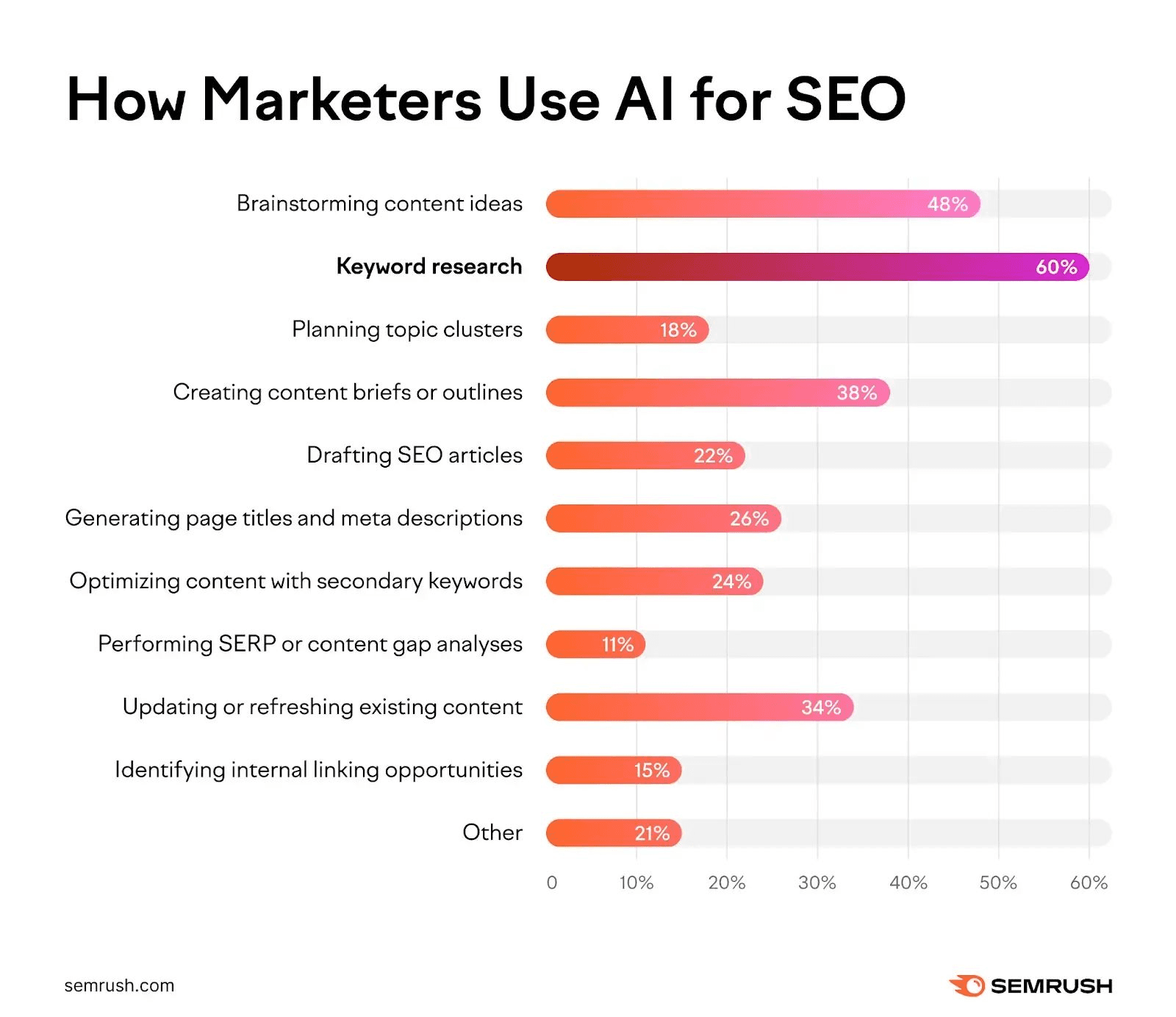
How Marketers Use AI in 2025: Data-Backed Insights
Source: SeMrush
1. AI for Strategy and Ideation (Highest Adoption)
This is where AI clearly wins in 2025.
Keyword Research – 60%
Keyword research is the most common AI use case.
What this tells us:
- AI is trusted to analyze search patterns at scale.
- Marketers rely on AI to surface keyword opportunities faster than traditional tools alone.
- Speed and breadth matter more than perfect precision at this stage.
Why it works:
AI is great at clustering intent, identifying variations, and spotting gaps humans would miss.
Brainstorming Content Ideas – 48%
Nearly half of marketers use AI for ideation.
What this really means:
- AI is being used as a thinking partner, not a writer.
- It helps break creative blocks and explore angles.
- Final judgment still stays human.
This aligns with how SEO has evolved. Volume matters less. Direction matters more.
Planning Topic Clusters – 18%
Lower adoption, but strategically important.
Why adoption is lower?
- Topic clustering requires brand context and business understanding.
- AI can assist, but marketers still want control here.
This is a signal, not a weakness. Strategic decisions still belong to humans.
2. AI for Content Creation and Optimization (Selective Trust)
AI is used carefully when it comes to execution.
Creating Content Briefs or Outlines – 38%
This is a sweet spot.
Why marketers like this use case:
- AI structures information well.
- It speeds up briefing without risking brand voice.
- Writers still own the final output.
AI sets the frame. Humans fill it.
Drafting SEO Articles – 22%
Noticeably lower adoption.
What this tells us:
- Marketers don’t fully trust AI-written content to rank or convert on its own.
- Quality, originality, and experience still matter.
- AI drafts are often rewritten heavily or used only as rough input.
This is a reality check for anyone thinking AI has replaced writers. It hasn’t.
Optimizing Content with Secondary Keywords – 24%
A practical, low-risk use.
Why this works:
- AI is good at semantic analysis.
- It helps avoid keyword stuffing.
- It supports topical relevance without manual scanning.
Generating Page Titles and Meta Descriptions – 26%
Another efficiency play.
Marketers use AI here because:
- It’s fast.
- It’s easy to test variations.
- The risk is low and reversible.
3. AI for Analysis and Maintenance (Early Adoption)
This is where AI usage is still cautious.
Updating or Refreshing Existing Content – 34%
This number is quietly important.
Why it matters:
- Content decay is real.
- AI helps identify outdated sections and missing angles.
- Refreshing beats publishing new content for ROI.
Expect this number to grow fast.
SERP or Content Gap Analysis – 11%
Surprisingly low.
Why:
- These tasks require a competitive context.
- Marketers don’t fully trust AI to interpret SERPs correctly yet.
- Tools still require manual validation.
This is more about confidence than capability.
Identifying Internal Linking Opportunities – 15%
Another underused area.
The opportunity:
- Internal linking is tedious and scalable.
- AI can excel here once trust improves.
- This is likely a growth area in the next 12–18 months.
4. What These Stats Say About AI Maturity in 2025
Here’s the pattern:
- High usage → idea generation, research, structuring
- Medium usage → optimization, refreshing, metadata
- Low usage → judgment-heavy analysis and final output
In other words:
AI is a multiplier, not a replacement.
A 2026 Prediction
Here’s a grounded prediction based on current adoption curves:
In 2026, the most successful marketers won’t be the ones who use AI the most, but the ones who use it most deliberately. Expect AI adoption to double in content maintenance, internal linking, and SEO refresh workflows, while fully automated content creation remains limited to low-risk pages.
The shift won’t be louder AI. It will be quieter, deeper integration.
How to Make Decisions Using These Stats?
Let’s turn data into action.
If You’re a Solo Marketer or Small Team
Prioritize AI for:
- Keyword research
- Content ideation
- Brief creation
- Meta titles and descriptions
Why:
These give the biggest time savings with the least risk.
If You Run an Agency or Content Team
Use AI for:
- Topic research and clustering
- Content refresh workflows
- Secondary keyword optimization
- Internal linking suggestions
Avoid:
- Publishing raw AI drafts without editorial oversight
Use AI where:
- Scale matters more than nuance
- Pattern recognition beats intuition
- Speed creates competitive advantage
Keep humans where:
- Brand voice matters
- Trust and experience influence conversions
- Strategic trade-offs are required
The Bottom Line
2025 data makes one thing clear.
Marketers aren’t asking “Can AI do this?”
They’re asking, “Where does AI actually help?”
Right now, AI helps most where thinking is broad, repetitive, or structural. It helps least where judgment, credibility, and accountability matter.