SEO isn’t a fringe marketing tactic anymore. It’s become a core channel businesses fund year after year because it compounds over time in ways paid channels do not.
More than 70 % of marketers reported that organic search delivered higher long-term ROI than paid channels, and many CMOs said they will protect or grow SEO budgets even when overall budgets are tight.
That shift in mindset matters. What this means is companies no longer treat SEO as optional or experimental. They expect it to generate sustainable visibility, leads, and conversions, and they hold teams accountable for performance results.
Typical SEO Budget Ranges (Actual Spend Data)
There’s no one single number that fits every business. But multiple surveys and pricing studies give a good picture of current ranges:
Monthly Retainers and Pricing (Typical across markets):
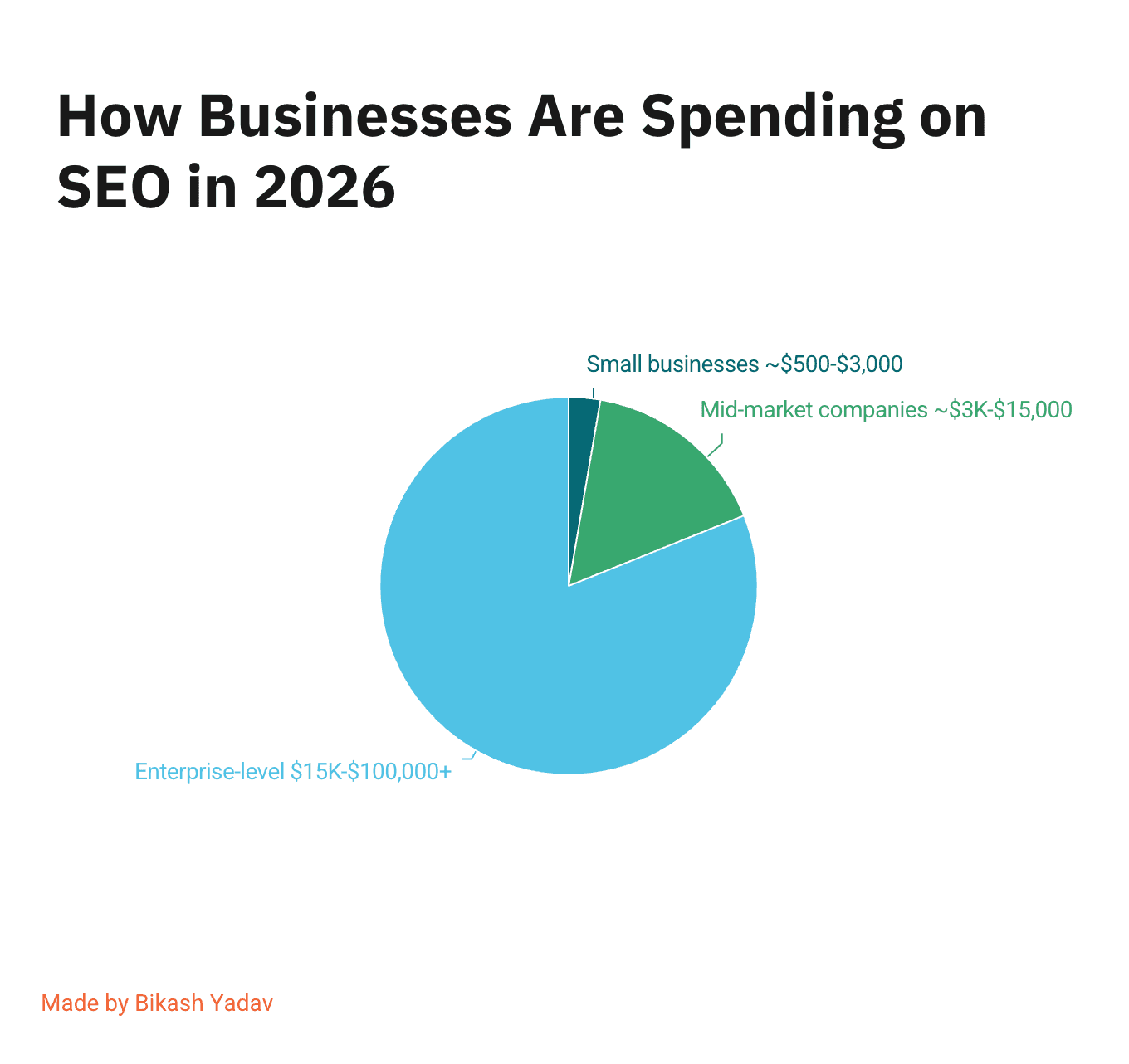
Pie chart of How Businesses Are Spending on SEO in 2026
- Small businesses: ~$500-$3,000 per month
- Mid-market companies: ~$3,000-$15,000 per month
- Enterprise-level SEO programs: $15,000-$100,000+ per month
Across global markets, quality SEO services in 2026 often run $1,500-$5,000 per month for most businesses, with some agencies charging up to $20,000 or more for enterprise programs.
Consultants and Specialists:
- Hourly consultants: $100-$300+ an hour
- Project-based campaigns: often $5,000-$30,000 for migrations or audits
SaaS and Tech Companies:
For SaaS with product-led growth, about 7 % of revenue goes toward SEO budgets; for more growth-driven models, it can be 10-15 % of revenue.
Where SEO Budgets Are Actually Spent?
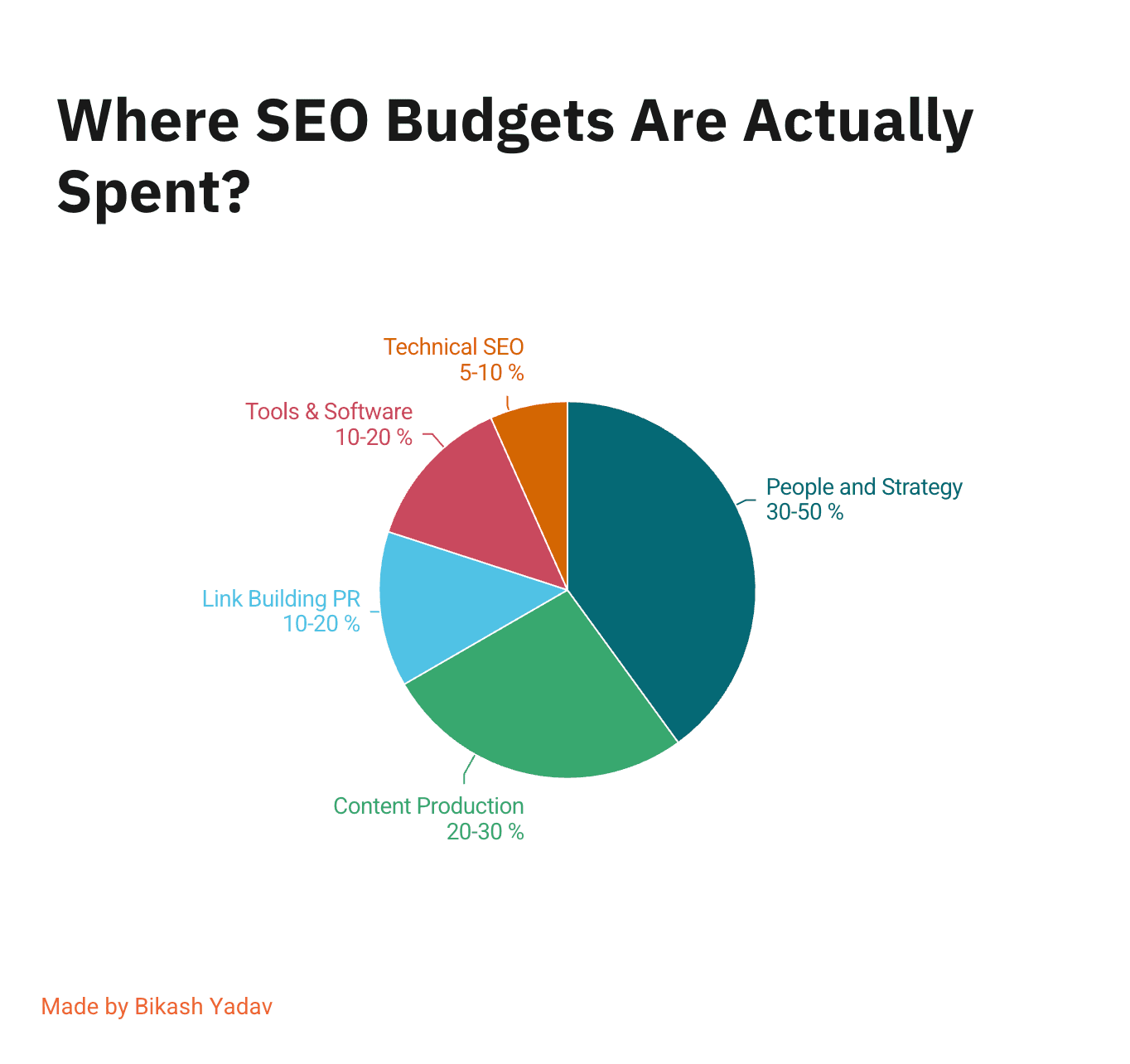
Pie chart of Where SEO Budgets Are Actually Spent
Budgets differ not just in size, but in allocation.
Typical allocations include:
- People and Strategy (30-50 %) – SEO expertise and planning
- Content Production (20-30 %) – blogs, landing pages, and AI-optimized content
- Link Building & Digital PR (10-20 %) – authority building
- Tools & Software (10-20 %) – analytics and automation
- Technical SEO (5-10 %) – site performance, crawlability, schema, etc.
Budgets increasingly shift toward data, strategy, and high-impact activities rather than repetitive low-value tasks. That’s where the ROI comes from.
The ROI of SEO
Businesses don’t invest blindly. SEO continues to show strong returns:
- SEO leads close at ~14.6 %, compared to 1.7 % for outbound channels.
- Organic search ROI can be 5x or more compared to paid search alone.
- Most SEO campaigns reach positive ROI between 6–12 months, and results compound in years two and three.
What this really means is: spending more today often yields greater revenue later, especially if you tie SEO efforts to strategic KPIs like traffic growth, conversions, and customer acquisition cost.
Regional Differences and Top Investing Countries (SEO & Digital)
Precise SEO-only spend per country isn’t always published, but global digital ad spend, which correlates with broader search investment, including SEO, gives us a usable proxy.
The top countries pumping money into digital and SEO-adjacent marketing in 2026 are:
- United States – biggest overall digital marketing spend in the world ($295 B).
- China – $150 B, rapid growth with strong online ecosystems.
- United Kingdom – advanced digital strategies + significant spend.
- Japan – a mature digital market.
- Germany – strong economic base.
- Canada – robust digital adoption.
- Australia – large per-capita digital spend.
- France – significant investment in online channels.
- Brazil – the biggest Latin American digital market.
- South Korea – mobile-first and highly tech-savvy.
What this tells you is where budgets are densest and where competitive pressure in SEO is highest.
How to Make Budget Decisions Based on These Stats?
Here’s a simple decision-making framework:
- Assess Your Goals First:
Are you focusing on awareness, lead gen, ecommerce transactions, or long-term brand visibility? Your SEO budget should map to these goals (e.g., content-heavy SEO if you want thought leadership vs. technical-driven SEO for e-commerce).
- Match Budget to Business Size and Competition:
If you’re a small or local business, a $2,000-$4,000 monthly investment might be sensible. Mid-market and enterprise companies should budget much higher because competitive keywords and authority require sustained work.
- Allocate by Impact:
Spend most on strategy and content because that’s where compounding ROI happens — not on low-value tactics that don’t scale.
- Benchmark Progress:
Track leading indicators like keyword rankings and organic traffic, then lagging ones like conversions and revenue share from organic. Look for break-even at 6-12 months, with escalated results after that.
- Adjust Based on Country Dynamics:
If your audience is in the U.S., UK, or other high-spend markets, expect a higher cost per result and plan your budgets accordingly. For emerging markets, you might get more value per dollar, but also face different search behaviors.
A Quote Prediction for SEO Investment in 2026
Here’s a forward-looking statement that captures what many marketing leaders are thinking:
“In 2026, investing in search optimisation will be less about chasing rankings and more about building discovery engines that scale. Companies that align SEO spend with strategic business outcomes, not just traffic, will see compounding returns that paid media can’t match.”