A Google Business Profile (GBP), formerly Google My Business, is a free local listing that displays your business information on Google Search and Maps.
It typically includes your address, phone, website, hours, reviews, and more, often appearing in the sidebar or Local Pack results (the map and three-pack of listings).
For local businesses, a GBP is essentially your digital storefront on Google.
Why does GBP visibility matter so much? Consider that 46% of all Google searches have local intent. When people search “coffee shop near me” or “best plumber in [City]”, Google often shows local GBP listings first.
Crucially, appearing prominently can directly drive customers: 76% of people who search for something nearby on their smartphone visit a related business within a day, and 28% of those searches result in a purchase.
In other words, high GBP rankings can translate into real-world traffic and sales. With so much at stake, understanding the ranking factors behind Google Business Profiles is vital.
In this comprehensive guide, we’ll break down the key factors that influence your GBP rankings and share data-backed insights (from Google, BrightLocal, and industry research) on how to optimize each aspect.
Key Factors That Influence Your Google Business Profile Rankings
Google’s algorithm for local search involves a mix of relevance, proximity, and prominence signals.
Below, we explore each of these and other important factors in detail, with proven statistics and tips to boost your local visibility.
Relevance refers to how well your GBP matches what someone is searching for. To maximize relevance, ensure all your business info on Google is specific and up-to-date.
Google itself advises providing “complete and detailed business info” so it can better match you to relevant searches. Here are three key ways to improve relevance:
Optimize Business Categories: Choose the most appropriate primary category and add secondary categories that reflect your services.
The category tells Google what type of business you are, directly affecting which searches you’ll appear in.
In fact, a survey of local SEO experts in 2023 ranked the primary GBP category as the #1 factor for Local Pack rankings. (Additional categories also made the top 10.)
This underscores that if you’re a bakery, selecting “Bakery” (and perhaps “Cafe” if you serve coffee, etc.) is crucial – it makes your listing relevant for those keyword searches.
Use Accurate, Keyword-Rich Descriptions: Write a clear business description that highlights your offerings and location.
While the description field on GBP may not directly boost rankings like categories do, it still contributes to relevance by telling Google (and customers) what you do.
Include important keywords that customers use (e.g., “authentic Italian pizza”, “24/7 emergency plumbing”) in a natural way.
This can improve your chances of matching niche queries. Google allows up to 750 characters in the description, but only the first ~250 characters show in the knowledge panel – so prioritize your most important info early.
Most importantly, be accurate and avoid keyword stuffing. For example, instead of “Best Pizza Italian Pizza Pizza”, say “Authentic Neapolitan pizzeria serving wood-fired pizzas in downtown Denver.” A detailed, truthful description builds relevance and trust.
Add Relevant Products/Services: Take advantage of GBP’s features to list your specific products or services. If you run a salon, list your hair, nail, or skincare services; if you’re a hardware store, list products or categories you carry.
Adding these not only makes your profile more informative, but can also help you show up for more specific searches. Google can display your listed products/services in search results, and it helps connect you with queries for those items.
For example, a user searching “iPhone screen repair [City]” might see an electronics repair shop’s profile if that service is explicitly listed.
Providing a comprehensive list of offerings increases your relevancy footprint. It’s essentially feeding Google more keywords and content about your business (in a way that’s user-friendly and not spammy).
In short, the more precisely your GBP information matches a searcher’s intent, the better your chances of ranking. Optimizing categories is especially impactful – experts call it one of the biggest levers for local SEO.
And while description and services may be softer signals, they round out your relevance and can improve conversion by giving searchers the exact info they need.
2. Proximity to the Searcher
Proximity (Distance) is a major factor in local search rankings – essentially, how close your business is to the person searching.
All else being equal, Google will usually favor businesses nearer to the searcher’s location. If someone in downtown searches “bookstore”, Google is likely to show nearby bookstores rather than one 20 miles away, even if that far-away store is highly rated.
This makes intuitive sense: users often prefer convenient, close-by options.
Google determines proximity using the location of the search query. On a phone, it might use GPS; on a computer, it could use the IP address or the location set in Google.
If the searcher specifies a location (e.g., “bookstore in London”), Google will center results on that area. If not, it assumes “near me” and uses the searcher’s known location.
Proximity has become even more critical after Google’s “Vicinity” update, which increased the weight of the searcher’s location in ranking decisions. In the 2023 Local Ranking Factors survey, experts rated the “proximity of address to the point of search” as the #3 factor for Local Pack rankings, only behind category and business name keywords.
Having a physical address within the city or area being searched can be a big advantage – “physical address in city of search” was also a top factor (#4) in that survey.
So what can you do about proximity? You can’t change your location for each searcher, but you can ensure Google knows the areas you serve and try strategies to broaden your reach:
Set Your Service Area (for Service Businesses): If you don’t operate from a brick-and-mortar location (e.g., plumbers, mobile pet groomers), you can mark a service area in your GBP. This tells Google and users the general region you cover.
However, don’t assume that simply adding far-away towns to your service area will boost your ranking there. Evidence suggests it doesn’t directly improve your visibility in those distant areas.
A case study by Whitespark found that adding or changing service areas had no significant impact on rankings. Google still bases your ranking primarily on the address where your business is verified, even if that address is hidden.
In other words, if your home base is in Saratoga Springs, Google will use that as the anchor point for your “near me” searches.
Don’t list a bunch of far-off cities in hopes of magically ranking there – it won’t override the physics of distance.
Improve Prominence to Extend Reach: While you can’t alter physical distance, boosting your overall prominence (see the next section) can sometimes help you appear in a wider radius.
A business with very high authority and great reviews might show up for users slightly further away, especially if there are few closer alternatives.
For instance, someone on the edge of town might still see a well-known downtown restaurant in results because of its prominence.
You can improve this by building strong reviews, backlinks, and engagement. Think of prominence as “gravity” that can pull in searchers from farther away. We’ll discuss those tactics soon.
Consider Multiple Locations: If your goal is to rank in a city where you’re not physically located, the most reliable method is to establish a presence there (e.g., open a new location or office).
Some businesses also use coworking spaces or virtual offices to have an address in another city – but be cautious: listing a “virtual” address that you’re not actually staffed at can violate Google’s guidelines and lead to suspension.
It’s better to legitimately expand or focus on organic SEO for that city (so you appear in regular results, if not the map pack).
Unfortunately, proximity is a factor largely outside your control; it’s determined by where the searcher is. Google’s own help page confirms, “Distance refers to how far each business is from the location term used or the searcher’s location”.
The best practice is to ensure your address is correctly set and consider targeting local keywords on your website (like mentioning nearby neighborhoods) for organic reach.
But remember, a small local business will naturally rank well for nearby searchers and likely won’t rank at all for someone 50 miles away.
Even big brands are subject to this physics – a user in Manhattan won’t see Los Angeles stores in their “near me” results. Focus on your core area and excel there, rather than trying to cheat the proximity factor.
Tip: If you operate in a big city or densely populated area, proximity becomes hyper-local. Sometimes, even a mile or two can make a difference in appearing in someone’s 3-pack.
On the flip side, in a rural area or small town, you might rank across a larger radius by default because there are fewer competitors. Always consider the local context.
3. Prominence and Online Authority
Prominence is essentially how well-known and authoritative your business is – both offline (in the “real world”) and online.
Google describes prominence in local ranking as a measure of “how well-known a business is,” and it takes into account information like “how many websites link to the business” as well as how many reviews and positive ratings it has.
This factor is akin to the traditional SEO concept of authority: if your business is talked about a lot and has a strong reputation, Google will likely rank it higher in local results.
Key elements that contribute to prominence and authority include:
Local Backlinks (Inbound Links): Backlinks are links from other websites to your business’s website. They have long been a cornerstone of SEO, and for local SEO, quality matters more than quantity. Links act like votes of confidence.
Particularly valuable are links from other local or industry-relevant sites – for example, a news article in your city’s online newspaper linking to your site, or a local chamber of commerce directory listing.
Google’s local algorithm specifically mentions backlinks as a factor, and experts agree. In Whitespark’s 2023 study, one highly rated factor was the quantity of inbound links from locally relevant domains to your site.
In practice, a law firm in Boston benefits from links on Boston community sites or .gov pages in Massachusetts.
A strong local link profile boosts your credibility in Google’s eyes. One pro tip: pursue sponsorships or partnerships – e.g., sponsor a local charity event and get a link on their site, or write a guest column for a local blog.
According to one analysis, locally relevant links were among the top factors for higher local rankings.
Brand Mentions and Citations: Even when there’s not a direct link, your business being mentioned around the web contributes to prominence.
A citation is any online mention of your business’s Name, Address, and Phone (NAP) – think online directories like Yelp, Yellow Pages, TripAdvisor, Facebook business pages, etc.
Ensuring your business is listed on major platforms (and niche local sites) helps Google verify your existence and legitimacy. It’s not just about being listed: consistency is key (more on that shortly).
Additionally, if your business gets written up in press articles or local blogs (even without a hyperlink), those mentions can improve prominence by associating your name with keywords and location in Google’s entity knowledge graph.
For example, a local restaurant featured in “Best Eats in Denver 2025” articles on popular sites will likely get a prominence boost. While the influence of citations on ranking isn’t as dominant as it once was, they are still a foundational signal.
They also directly impact consumer trust: 62% of consumers say they would avoid a business if they find incorrect information about it online.
So having widespread, accurate citations can both improve your standing with Google and ensure customers don’t encounter wrong details that drive them away.
Consistency Across Directories (NAP Consistency): As mentioned, consistency of your Name, Address, Phone across the web is crucial. Google cross-references multiple sources to confirm your business details.
If your address is “123 Main St.” on your website, but “123 Main Street, Suite 4” on Yelp and an old address on Facebook, that inconsistency can erode Google’s confidence.
At best, it might rank you a bit lower; at worst, it might confuse your customers. The impact is real – recall that 62% of consumers would avoid a business with incorrect info, which includes wrong addresses or phone numbers.
In terms of ranking, local SEOs believe citation consistency still plays a role in Google’s prominence assessment. Make sure to audit your listings on major sites (Google, Bing, Facebook, Yelp, Apple Maps, etc.) and update any old or misspelled info.
Use a standard format for your address and stick to it everywhere (e.g., always abbreviate “St.” or always spell “Street” – don’t mix). The more signals pointing to the same accurate NAP, the more “prominent” and real your business appears.
Prominence also comes from offline factors that may surface online – e.g., if your business is a landmark or well-known brand, it likely has many reviews, news articles, or Wikipedia entries that Google picks up. While you can’t fabricate being famous, you can work to build your online authority step by step: earn local links, encourage press mentions, list your business on reputable directories, and maintain consistency. Over time, these efforts accumulate into a stronger prominence signal. Google notes that “prominent, well-known locations” (like museums or big retailers) naturally rank well – but even as a small business, you can improve your prominence by becoming well-known in your community and industry.
Lastly, online reviews (quantity and quality) are a huge part of prominence – so big that they deserve their own section. Let’s explore that next.
4. Google Reviews and Engagement
Few things influence local shoppers – and Google’s local algorithm – as much as customer reviews. Reviews are a direct signal of trust and experience.
Google’s support page explicitly states, “More reviews and positive ratings can help your business’s local ranking.”
Here’s how reviews and engagement around them impact your GBP ranking:
Quantity and Quality of Reviews: Generally, businesses with more reviews (especially recent ones) and higher average ratings tend to rank better. A company with 200 reviews and a 4.7-star average will usually outrank a similar one with 5 reviews at 4.0 stars, all else equal. Reviews act as crowd-sourced credibility.
According to BrightLocal’s consumer survey, 71% of consumers say they would not even consider using a business with an average rating below 3 stars – so falling below that threshold can severely hurt your ability to attract customers, even if you rank.
But ranking itself is influenced by these metrics: local SEO experts consistently rank high numerical Google ratings and the quantity of Google reviews among the top local ranking factors.
In 2023, factors like “High average star rating”, “Quantity of native Google reviews”, and “Presence of positive sentiment in review text” all appeared in the top 20 factors for local pack rankings.
In short, having a lot of good reviews is one of the clearest indicators of prominence – and it boosts both your visibility and conversion rate. Strive to steadily gather genuine reviews from your customers.
Responding to Reviews: Google encourages business owners to respond to reviews, and doing so can indirectly help your ranking. While simply responding doesn’t add keywords or change your star rating, it does signal that you are active and care about customer feedback.
This can influence how users engage with your listing (people may trust you more, leading to more clicks or calls – which could be behavioral ranking signals).
Moreover, responding to reviews can improve your reputation: 88% of consumers say they would use a business that responds to all reviews (both positive and negative), whereas only 47% would consider a business that doesn’t respond to reviews at all.
That’s a huge difference in public perception. Google likely notices if a business regularly responds (especially to negative reviews to resolve issues, as this indicates good customer service. At the very least, responses make your positive reviews stand out and can mitigate the damage of negatives by showing your side of the story.
As a best practice, thank people for positive reviews and professionally address issues raised in negative ones.
It won’t magically raise your star average, but it can win over future customers and contribute to a healthier profile.
Google’s own words: “When you reply to customer reviews, it shows that you value their feedback” – helpful replies and high ratings can help your business stand out.
Review Velocity and Freshness: It’s not just how many reviews you have, but also how recent and regular they are.
A business might have 100 reviews from 5 years ago, whereas a competitor has 50 reviews with new ones every week – the latter is likely more favored now. Fresh reviews indicate you’re actively serving customers and staying relevant.
Indeed, the importance of recency and a steady influx of reviews was highlighted by local SEO experts: maintaining a consistent stream of new reviews (rather than a sudden spike and then silence) was rated highly in importance.
This suggests Google pays attention to review “freshness.” Many consumers do, too – BrightLocal’s surveys have shown that people tend to read mostly recent reviews (within the last few months) to judge a business.
As such, try to solicit reviews on an ongoing basis. For example, incorporate a gentle request for a Google review in your post-purchase or post-service follow-ups.
Even a trickle of 2-3 new reviews each month can keep your profile fresh in Google’s eyes. Conversely, having no new reviews for a year might make your business look inactive or less relevant.
Engagement with Reviews (Clicks & Keywords): Interestingly, the content of reviews can also influence your ranking for certain terms. If many people mention a specific product or service in your reviews, Google might rank you higher for queries related to that term.
For instance, if you’re a diner and lots of reviewers mention your “vegan options,” you might start to rank for “vegan-friendly restaurants” searches. This is known as review keywords or review content analysis.
It’s not something you can easily control (aside from providing great offerings that people naturally talk about), but be aware that reviews contribute to your semantic relevance.
Additionally, high engagement (people clicking to read reviews, upvoting them, etc.) might also tell Google your listing is of interest to users.
To maximize the benefit of reviews: provide excellent service (so you earn positive reviews), remind happy customers to leave feedback on Google, and always follow Google’s review policies (never buy reviews or incentivize them in a way that violates guidelines).
Volume, velocity, and sentiment all count. And remember – reviews affect ranking, but also whether someone clicks your listing at all. It’s a double-edged sword: ranking #1 won’t matter if you have a 2-star rating that scares customers away. Aim for quality and quantity.
Also, don’t ignore Google’s Q&A section (if available on your profile – it has been phased out in late 2025 for some, but many profiles still have it).
This is a feature where the public can ask questions on your GBP, and anyone can answer. It’s separate from reviews but also reflects engagement.
Monitor those questions and provide authoritative answers to your own Q&A. If you leave them unanswered, someone else might give an incorrect answer.
By handling Q&A, you show attentiveness – which can only help your profile’s appeal.
5. Regular Posts and Updates
Keeping your Google Business Profile active with posts and updates can influence your visibility and user engagement. Google Posts are like mini-updates or micro-blogs (up to 1,500 characters, plus a photo) that appear on your profile.
They can announce events, offers, products, or news. While posts might not carry heavy direct ranking weight, they feed Google fresh content and signals that your business is active. An active profile is thought to be treated more favorably than a stagnant one.
So, how often should you post? The conventional advice was at least once per week because posts expire from the default view after 7 days.
However, recent insights suggest that posting weekly may not provide significantly more benefit than posting regularly, but less frequently.
One analysis of local ranking factors noted that the positive impact of very frequent posting has diminished – posting once a month is now considered sufficient to gain the benefits of Google Posts.
In other words, you don’t need to stress about creating content every few days; focus on making posts when you have something meaningful to share (a sale, a new service, a seasonal greeting, etc.), and aim for consistency over time rather than sheer volume. Even a steady cadence of one post every 2-4 weeks keeps your profile “fresh” in Google’s eyes and shows users that you’re active.
Of course, if you have more to say, you can post more often – just ensure the content quality is high.
Types of content that work well: Posts with engaging visuals and clear calls-to-action tend to perform best. Some effective post types include:
- Promotions or Discounts: If you’re running a special deal (“10% off all orders this week”), post about it. You can even use the “Offer” post format, which lets you add a title, coupon code, and validity dates.
- Events: Hosting a workshop, webinar, or in-store event? Use an Event post to list the date and details; it will show up on your profile and even on Google Maps.
- Product Highlights: Feature a new or popular product with a nice photo and a blurb. For services, you might highlight a service of the month.
- Company News or Milestones: Did you just open a new branch, win an award, or reach 1,000 customers? Share the good news. Humanizing your business can encourage engagement.
- COVID-19 or Critical Updates: Google has special post types for updates about health & safety or changes in hours/policies (these were widely used during the pandemic). Keeping customers informed builds trust.
Remember to include a call-to-action (CTA) in your posts when relevant. Google provides buttons like “Learn more”, “Call now”, “Book”, “Sign up”, etc.
If your post is about a service, maybe use “Book” to drive appointments; if it’s about a blog article or announcement, use “Learn more” with a link. These CTAs can lead to direct customer actions.
Engagement metrics and ranking influence: While Google hasn’t said “posts boost your ranking by X”, there is evidence they have a mild, indirect impact.
Case studies cited on Search Engine Land have shown “a mild impact on local search rankings” from posting, with the ranking uptick lasting weeks or months after the posts.
This suggests that an active profile gets a slight algorithmic nudge, possibly because Google sees the business as more up-to-date or because users interact with it more.
Additionally, posts can drive user engagement signals that are known to matter (like clicks to your website or time spent on your profile).
According to data by SOCi, Google Posts can achieve an average click-through rate of 1.44%, which is actually higher than typical social media or display ad engagement rates.
That means out of the people who view your profile, a decent chunk might click your post or its link, leading to website traffic or conversions. More engagement can potentially lead to ha igher ranking due to user behavior signals.
At the very least, those clicks are potential customers checking out your site or offer.
To sum up, don’t let your GBP go dormant. Use Posts to keep it fresh. It not only can help your rankings marginally, but more importantly, it offers fresh reasons for customers to choose you.
An active profile with recent posts, up-to-date hours, and timely info will stand out next to a rival that hasn’t updated anything in a year. In local SEO, activity often correlates with competitiveness.
So schedule a reminder to post something at least once a month. If you have no news, you can always share a customer review highlight or a tip related to your business – be creative.
They say “a picture is worth a thousand words,” and on your Google Business Profile, it might also be worth a thousand views.
Photos and other media (like videos and virtual tours) on your GBP have a significant impact on both user engagement and search performance.
Google’s own data underscores this: businesses with photos on their profiles receive 42% more requests for driving directions and 35% more clicks through to their websites than businesses without photos.
That’s a massive difference in customer actions, directly attributable to having photos! Visually rich profiles attract more attention – people are more likely to click on a listing that showcases what the business looks like or what it offers.
An example of a Google Business Profile showing user engagement features: a Q&A section where customers can ask questions (and get answers), and a “Popular Times” chart indicating when the business is typically busy.
Keeping these sections updated and responding to queries can improve user satisfaction and, indirectly, your local SEO.
Why images matter in local search: Beyond the appeal to users, Google’s algorithm also appears to favor profiles that actively add photos. A guide on optimizing GBP photos noted that Google’s algorithm favors businesses that regularly update their profile with fresh, high-quality photos.
It makes sense – uploading photos is a sign of an active business. Additionally, images can help Google understand your business better through AI (for instance, identifying if you have a storefront, the nature of your products, etc.).
But most importantly, images build trust and interest. Imagine a hotel profile with crisp photos of the rooms and pool, versus one with no photos; the one with photos is not only more likely to be clicked, but Google might rank it higher because it better satisfies what users want to see.
In many industries (restaurants, hospitality, retail), photos are the first thing users look at – often even before reviews.
Having a robust gallery of images can significantly increase engagement with your listing (which in turn can boost rankings via user behavior metrics).
Best practices for uploading photos: First, ensure you add a variety of photos: your logo and a clear cover photo (these help with branding), plus additional images of your storefront, interior, products, staff, menu, work samples, etc.
Google lets you categorize them (Exterior, Interior, Team, At Work, etc.). Aim for well-lit, high-resolution images. Blurry or poorly lit photos can actually deter customers.
Geotagging photos (adding location data in the file) isn’t necessary – Google strips metadata – but the content of the image should be relevant.
Also, name your image files descriptively before uploading (e.g., sunrise-cafe-patio.jpg vs. IMG_1234.jpg) – while it’s unclear how much that affects SEO, it can’t hurt and may slightly inform Google’s image recognition.
Regularly update photos – add new ones when you redecorate, launch a new product line, host an event, etc.
This continuous flow can signal that you’re an active business. As an example of impact, Google has stated that listings with photos and a virtual tour generate twice as much interest as those without visual media.
That “interest” translates to more clicks, calls, and ultimately a higher ranking because the listing is engaging more people.
Don’t overlook videos: Google allows short videos (up to 30 seconds, though up to 1 minute may be accepted via the dashboard) on profiles. A quick video tour of your store or a how-to clip related to your services can make you stand out.
Videos auto-play (muted) in the photos section, which can catch the eye. While few businesses use videos, those that do often impress customers.
Virtual Tours (360° photos / Street View inside your business) are another powerful media element. You can hire a Google Street View Trusted Photographer to create a virtual tour.
Google noted that listings with a virtual tour are far more likely to generate interest – customers can “step inside” your location virtually, which builds comfort and confidence.
As cited earlier, having a virtual tour plus photos can double viewer interest. Especially for hospitality, retail, and real estate, this can be a game-changer.
In summary, fill out your GBP’s visual content generously. It can directly boost user engagement metrics, which are believed to influence ranking.
And even if it didn’t influence the algorithm, the impact on customers is undeniable – profiles with rich media simply get more traffic.
As a rule of thumb, have at least 5-10 good photos to start, and keep adding over time (businesses that regularly update photos reportedly see improved performance).
Given that adding photos is free and relatively easy, it’s a high-ROI activity for local SEO. Don’t let your profile look like a ghost town – bring it to life with images and videos that tell your brand’s story.
7. Website and Landing Page Relevance
Your Google Business Profile doesn’t exist in isolation – it’s closely tied to your website. The link you provide on your GBP (“Website” field) and the content of that page can influence your local ranking.
While GBP-specific factors (like categories, reviews, etc.) carry a lot of weight, Google also considers your website’s relevance and authority as part of local SEO (especially for the localized organic results that often appear under the map pack). Here’s what to focus on:
Link to a Local-Optimized Landing Page: Ensure that the website URL on your GBP leads to the most relevant page for local visitors.
For single-location businesses, this is often your homepage. For multi-location businesses, it should be the specific location page for that branch.
Additionally, if you offer multiple distinct services, some experts recommend linking to the page most relevant to your primary service (though generally the location page is best).
The content on that landing page should clearly include your business name, address, phone, and details of your services/products – essentially reinforcing all the info on your GBP.
The page’s title tag should ideally mention your business and location (e.g., “Joe’s Plumbing – Plumber in Chicago, IL”).
According to the 2023 local search factors, having geographically and topically relevant content on your site is crucial: for instance, experts ranked “keywords in the GBP landing page title” and “geographic keyword relevance of domain content” among the top factors for local organic rankings.
If your GBP links to a general corporate homepage that says nothing about your city, that’s a missed opportunity. Instead, link to a page that screams local relevance (with maybe a map embed, local testimonials, etc.).
Google will find it easier to associate you with local search queries as a result.
Page Speed and Mobile-Friendliness: A huge portion of local searches happens on mobile devices – by some estimates, over 60% of local searchers use smartphones.
Google has moved to mobile-first indexing, and page speed is a known ranking factor (albeit a minor one for most sites).
But speed has a major effect on user experience: 53% of mobile site visits are abandoned if a page takes longer than 3 seconds to load. If someone clicks your website from your GBP and it loads slowly, they might bounce – sending negative signals and losing you a potential customer.
Make sure your site is optimized: compress images, use caching, and implement a responsive design. Mobile-friendliness is non-negotiable; your site should display correctly on a phone, with tap-friendly buttons and readable text.
Google even uses a “mobile usability” assessment in its ranking algorithm. A fast, mobile-optimized site not only pleases users (improving conversion) but also ensures you’re not getting dinged in search due to technical issues.
Think of your GBP and website as extensions of each other – the professionalism and performance of one affects the other.
Local Schema Markup and Content Alignment: To bolster Google’s understanding of your business, consider adding LocalBusiness schema markup on your website. This is code (in JSON-LD format) that explicitly provides your business details (name, address, phone, hours, coordinates, etc.) to search engines in a structured way.
While schema markup alone isn’t a magic ranking booster, it can enhance how your listings appear (rich snippets) and ensure Google properly associates your website with your GBP.
It’s especially helpful for multi-location businesses (using multiple schema entries for each location page). Surprisingly, structured data is still underutilized – as of 2024, only about 12.4% of domains on the web use any schema markup, and even fewer use the LocalBusiness schema specifically.
This limited adoption is actually an opportunity: by implementing schema, you put yourself ahead of the 87% of businesses that aren’t leveraging it.
Schema can lead to rich results (like stars from reviews showing in organic results, if you include aggregateRating from your reviews).
In fact, one study found that pages appearing as rich results enjoy an 82% higher click-through rate on average than standard results.
More clicks can indirectly help your rankings. Apart from the schema, make sure your website content aligns with what your GBP states.
If your GBP says you offer “emergency HVAC repair”, your website should mention that service in detail – this consistency reinforces relevance.
Also, include your city name naturally in your site’s key pages (e.g., “Serving the Dallas area since 2005…”). All these on-page signals integrate with your GBP to create a strong local SEO one-two punch.
In summary, think of your Google Business Profile and your website as partners. GBP might get a user’s attention first, but your website often seals the deal with more information or conversion (booking, contact form).
From an SEO perspective, a high-ranking GBP usually goes hand-in-hand with a well-optimized website. High authority domains tend to lift their GBP in competitive markets.
So, continue doing general SEO on your site: get quality backlinks, produce useful content (maybe local guides or FAQs), and maintain technical health. The reward will be seen not just in your organic rankings but in your local pack rankings, too.
8. GBP Feature Usage and Completeness
Finally, one of the easiest wins in Google Business Profile optimization is simply using all the features Google provides – in other words, fully completing your profile. A comprehensive, active profile is favored by Google and more attractive to customers.
In fact, Google has indicated that businesses with complete information are “more likely to be matched with the right searches.”
There’s strong evidence that completeness correlates with better performance: businesses with a complete and accurate Google Business Profile are 2.7 times more likely to be considered reputable and get 7 times more clicks compared to those with missing information.
Moreover, Google data shows that such profiles are 70% more likely to attract location visits and 50% more likely to lead to a purchase by customers, versus incomplete profiles.
Those are huge impact metrics – essentially, filling out your profile thoroughly can directly translate into more traffic and sales.
What does “completeness” entail? Here are key GBP features to make sure you utilize:
Core Business Info: Double-check that every field is filled: business name (exactly as your real-world name), address (correct and properly formatted), phone number (preferably a local number, not just a call center or 800 number, to signal you are local), website, and hours of operation (including special holiday hours).
All of these should be kept current. An often overlooked detail is the business description – we covered adding a keyword-rich description for relevance, but it’s also a completeness factor.
Google gives you space to describe your business; not using it is a missed opportunity.
Attributes: Google Business Profile allows you to select various attributes that apply to your business. These can be factual (e.g., “Woman-owned”, “Wheelchair accessible entrance”, “Outdoor seating”, “Free Wi-Fi”) or subjective (like “Popular for lunch” which comes from user feedback).
Go through the available attributes in your dashboard and mark all that are relevant. These attributes not only show up on your profile, but some are filterable in Google Maps (for instance, users can filter restaurants by “wheelchair accessible” or “vegan options”).
If you haven’t indicated an attribute, you might be filtered out of some searches. Attributes also feed Google’s understanding of your business.
For example, if you mark “LGBTQ-friendly” or “Pet-friendly”, you could appear for searches specifically seeking those. Fill out as many as apply – it makes your listing more informative and casts a wider net for long-tail searches.
Products and Services: If you have a menu of services or a catalog of products, use the GBP interface to add them (if applicable to your category). This not only adds more keyword-rich content to your profile but also presents your offerings directly on Google.
For certain industries, Google even shows a “Products” carousel on your profile. By completing this, you improve the user experience (people can see what you offer at a glance) and boost relevance for those product/service keywords.
Booking and Messaging Features: Depending on your category, you may have additional features. Restaurants, for instance, can accept reservations via OpenTable or other platforms integrated into Google.
Service businesses might enable the “Request a Booking” button (through Google’s partners) or allow messaging so users can message you directly from the profile.
If these features are available, consider enabling them – Google tends to promote profiles that utilize their ecosystem features.
Plus, it reduces friction for customers (someone might choose you because they can instantly book an appointment without navigating away).
Questions & Answers (Q&A): As mentioned earlier, the public Q&A section is something to monitor. Write your own FAQs and answer them (yes, you can ask and answer your own question – it’s actually a good strategy to seed the Q&A with common queries).
By populating Q&A, you preempt others from providing answers, and you enrich your profile with more info. Note that in late 2025, Google started phasing out the public Q&A feature in favor of AI-generated Q&A, but many listings still have their existing Q&As visible. If yours does, keep it updated and answer any new questions promptly. It’s part of providing a complete experience to users who visit your GBP.
Posts and Photos: We’ve covered these in dedicated sections, but to reiterate: make use of Google Posts to share updates (don’t leave that section empty if you have news), and upload photos regularly.
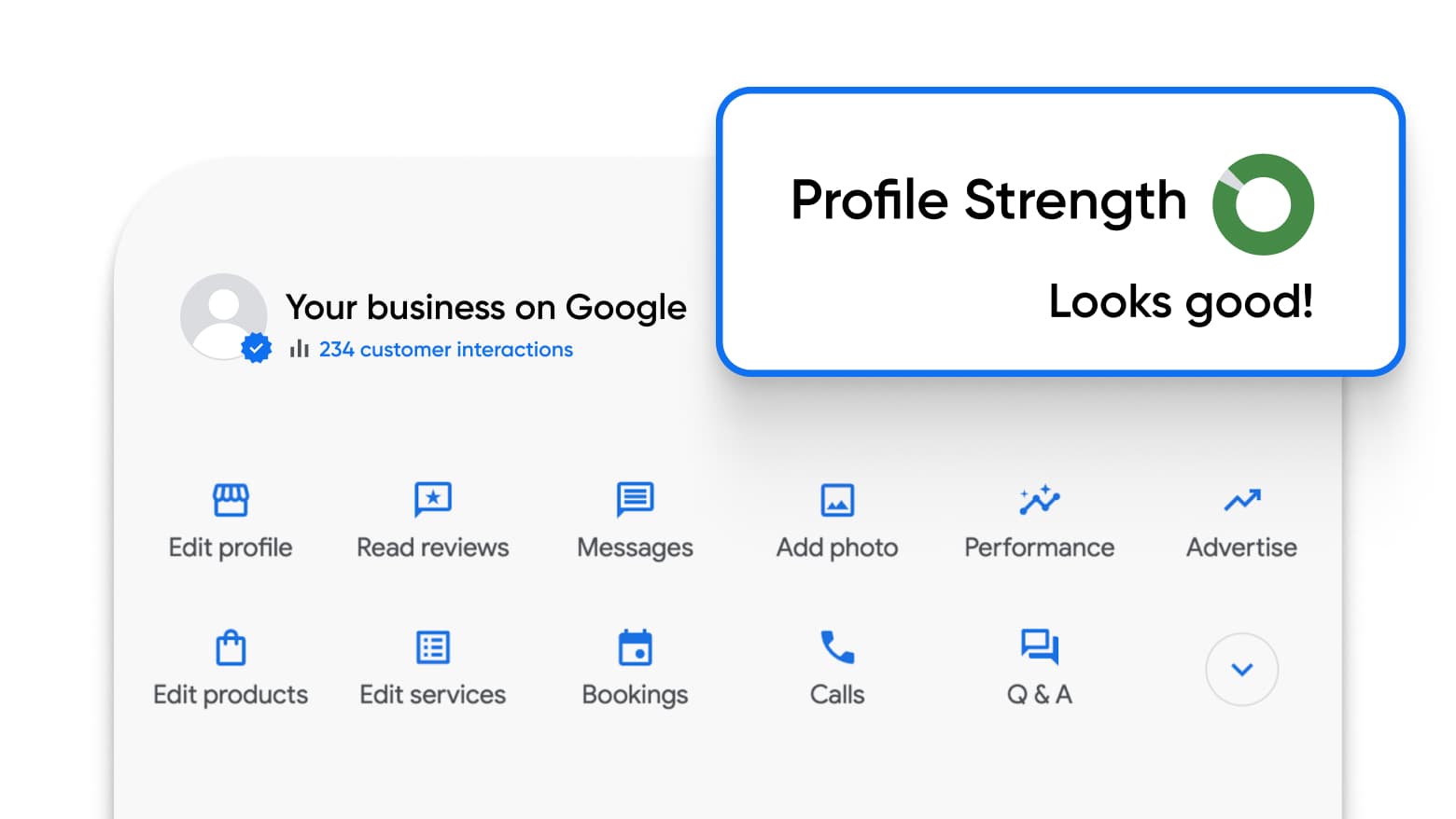
Profiles that are 100% complete have both of these sections filled out. An empty “Updates” section or a barren photo gallery is not ideal. Google’s own “profile strength” indicator (if you see it in your dashboard) will encourage you to post or add photos if you haven’t.
Reviews: Again, while you can’t “fill out” reviews yourself, encouraging customers to leave reviews and responding to them is part of maintaining a complete and robust profile.
A GBP with 0 reviews is technically complete in fields, but not in terms of content – aim to have at least a few reviews so your profile doesn’t look new or untested.
Ultimately, a complete profile leaves no field unfilled and takes advantage of all relevant features. Google has hinted that there is no one factor that guarantees ranking, but completeness is clearly correlated with better rankings and user trust.
Think of it from Google’s perspective: their goal is to show searchers the best, most informative results. A fully fleshed-out profile is more likely to satisfy the user, so the algorithm will favor it.
Moreover, many of these completeness steps (like adding attributes, products, etc.) directly add more keywords and content to your profile, which can help you rank for more search variations.
Take the time to audit your GBP and ask: Have I filled in everything I possibly can? If not, do it – it’s one of the simplest improvements you can make.
The statistics bear repeating: businesses with complete profiles get significantly more clicks and actions from customers. Don’t leave money on the table by neglecting these easy wins.
Common Mistakes That Hurt GBP Rankings
Now that we’ve covered the must-dos for boosting your Google Business Profile, it’s equally important to know the common pitfalls that can sabotage your efforts.
Even a well-optimized profile can suffer if you make certain mistakes that either violate Google’s guidelines or undermine user trust. Here are some frequent GBP blunders to avoid:
Inconsistent NAP Data
NAP means Name, Address, and Phone number. This is the core identity of your business online. When this information differs across platforms, it creates confusion for both Google and customers.
For example, if your business is listed as ABC Auto Repair on Google but ABC Auto and Tire Repair on Facebook, or your address sometimes includes Suite B and sometimes doesn’t, Google may struggle to connect all those mentions to one business. That weakens your local authority. Even worse, customers might call the wrong number or go to the wrong location.
This problem is bigger than it sounds. Studies show many people avoid businesses when they see incorrect contact details. If your phone number is different on Yelp and Google, some potential customers will simply give up.
To fix this, audit all listings such as Google, Bing, Yelp, Apple Maps, Facebook, and industry directories. Your business name, address, and phone number should be exactly the same everywhere. Standardize small details too, like Street vs St. or Suite 5 vs Ste 5. If you ever move or change numbers, update every listing fast.
NAP consistency is basic local SEO hygiene. It is not exciting, but it is critical.
Spammy Keyword Stuffing
Stuffing keywords into your business name or profile might seem like a shortcut, but it can seriously backfire. Google does not allow adding extra keywords or locations to your business name unless they are part of your legal name.
If your business is called Sunshine Dental, listing it as Sunshine Dental Best Teeth Whitening Braces City is a violation. Yes, keywords in the name can boost rankings, but Google actively penalizes this. Listings that break naming rules often get suspended or filtered out.
The same applies to cramming keywords unnaturally into your description or creating fake listings just to rank. These tactics can lead to ranking drops or full removal of your profile.
Other risky tactics include creating multiple listings for the same location, using virtual offices where you do not actually operate, or stuffing keywords into reviews and Q and A. All of these can trigger penalties.
The smarter move is simple. Use accurate categories, write natural descriptions, and keep your business name clean. Long term, playing by the rules wins.
Ignoring User Questions and Reviews
A Google Business Profile needs ongoing attention. Reviews and Q and A are two major areas where businesses often drop the ball.
If you never respond to reviews, especially negative ones, it looks like you do not care. That can turn away future customers. Most people read reviews before choosing a local business, and many trust businesses more when they see thoughtful responses.
Replying to positive reviews encourages more feedback. Responding calmly to negative ones shows professionalism and can even lead to updated ratings after issues are resolved.
The Q and A section matters too. If someone asks about parking or opening hours and no one answers, that is a poor experience. Worse, another user might give the wrong answer. Monitor questions and respond with clear, accurate information. Repeated questions are also clues about what you should highlight in your profile or website.
Engagement builds trust with users and sends positive signals about how active and reliable your business is.
Inactive Profiles With No Updates
An abandoned profile slowly loses ground. Google wants to show businesses that look active and up to date. If your profile has not changed in a year, while competitors are posting updates, adding photos, and collecting reviews, you are likely to fall behind.
You might not be removed for inactivity, but you miss out on important freshness signals. Regular posts, new photos, updated hours, and steady reviews all help keep your profile competitive. An outdated profile can even make customers wonder if you are still open.
Treat your profile like a living asset. Post updates at least monthly, add new photos every few months, update holiday hours, and consistently encourage reviews. Active profiles attract more clicks, calls, and visits, which can reinforce stronger performance over time.
An inactive profile does not just hurt rankings. It costs you real customers.
Conclusion
In the world of local SEO, your Google Business Profile is your MVP – a critical asset that can dramatically influence your local visibility and customer flow. We’ve explored the most impactful ranking factors: from ensuring relevance through accurate categories and keywords, to leveraging proximity by targeting your immediate area, to building prominence via links, citations and stellar reviews. We also delved into the power of user engagement – how active management of reviews, posts, and Q&A can set you apart – and the often underrated importance of completeness: filling out every section of your GBP and keeping it up-to-date.
The data speaks loud and clear. For example, we saw that complete profiles get 7× more clicks and far more customer actions. High review ratings and counts not only boost your ranking but are practically a prerequisite for consumer trust (remember, 71% won’t consider businesses under 3 stars). And with nearly half of all Google searches being local, the opportunity in optimizing your GBP is enormous – this is how you capture those searchers looking for what you offer right now in your area.
It’s important to recognize that local SEO (and Google’s algorithms) are ever-evolving. Factors can rise or dip in influence year to year. For instance, proximity became more influential recently due to an algorithm update, and Google might introduce new features (or retire old ones like the traditional Q&A) as search behavior changes. This means ongoing optimization and vigilance is key. Think of your GBP as a dynamic tool – check on it regularly, respond to new features Google rolls out, and adjust your strategy based on what’s working (for you and in the industry). Conducting a thorough GBP audit at least a couple of times a year is a great habit. Look at your analytics (Google provides insights on how people find and interact with your profile) to guide your improvements.
In summary, the most impactful ranking factors come down to doing the basics exceptionally well: provide the information searchers need, prove your relevance and quality through content and reviews, and engage with your profile actively. If you cover those bases, you’re aligning with what Google’s local algorithm is designed to reward.
Ongoing optimization is not just a fancy phrase – it’s a necessity. Competitors will be working on their profiles, and Google will be tweaking the dials of its algorithm. By staying proactive – keeping your info accurate, regularly adding content, earning fresh reviews, and polishing your local SEO on your website – you ensure that you maintain and improve your standings. The effort is well worth it: a top-ranking Google Business Profile can become a consistent source of leads and foot traffic, essentially for free.
So, recap and remember the heavy hitters: Relevance, Proximity, Prominence (with reviews as a star player), and Profile Completeness. Avoid the common pitfalls that diminish those strengths. If you invest time in your GBP with the strategies and tips outlined above, you’ll be positioning your local business to capture more eyeballs and wallets in your community. In an era where consumer decisions are heavily influenced by online visibility and reputation, your Google Business Profile is your golden ticket – treat it with care, keep it shining, and it will pay dividends in local growth.
Now, it’s time for action: go ahead and apply these insights to your own profile. Optimize, engage, and periodically audit your GBP as part of your local SEO strategy. The businesses that succeed locally are often those that marry great real-world service with great online presence. By understanding and leveraging GBP ranking factors, you’re aligning those two worlds – making it easy for new customers to find you, trust you, and choose you over the competition. Good luck, and happy ranking!