Global Search Engine Market Share in 2026

Tags:Global Search Engine Market Share
Written By
Bikash Yadav
SEO EXPERT
SEO Expert & Digital Marketing Strategist with 8+ years of experience helping businesses grow online. Read more
For anyone tracking where online traffic actually comes from, this is core data. Globally, in early 2026 (based on aggregated stats), the distribution looks like this:
Google’s dominance remains overwhelming: around nine out of every ten searches worldwide go through Google. Competitors trail far behind.
Here’s the thing: global averages hide big differences at the country level.
Google’s share goes way up, with nearly 97 % of searches coming through Google in India.
In Russia, local preference swings heavily toward Yandex, as much as 76 % of web search traffic.
Google still dominates with around 92 %, while Bing and Yahoo remain very small players.
Regional patterns matter if your traffic comes from specific nations, languages, or markets.
Search behavior changes by device. One breakdown shows:
Mobile is where Google’s dominance really spikes.
Here’s a simple bar chart representation for the 2026 global data:
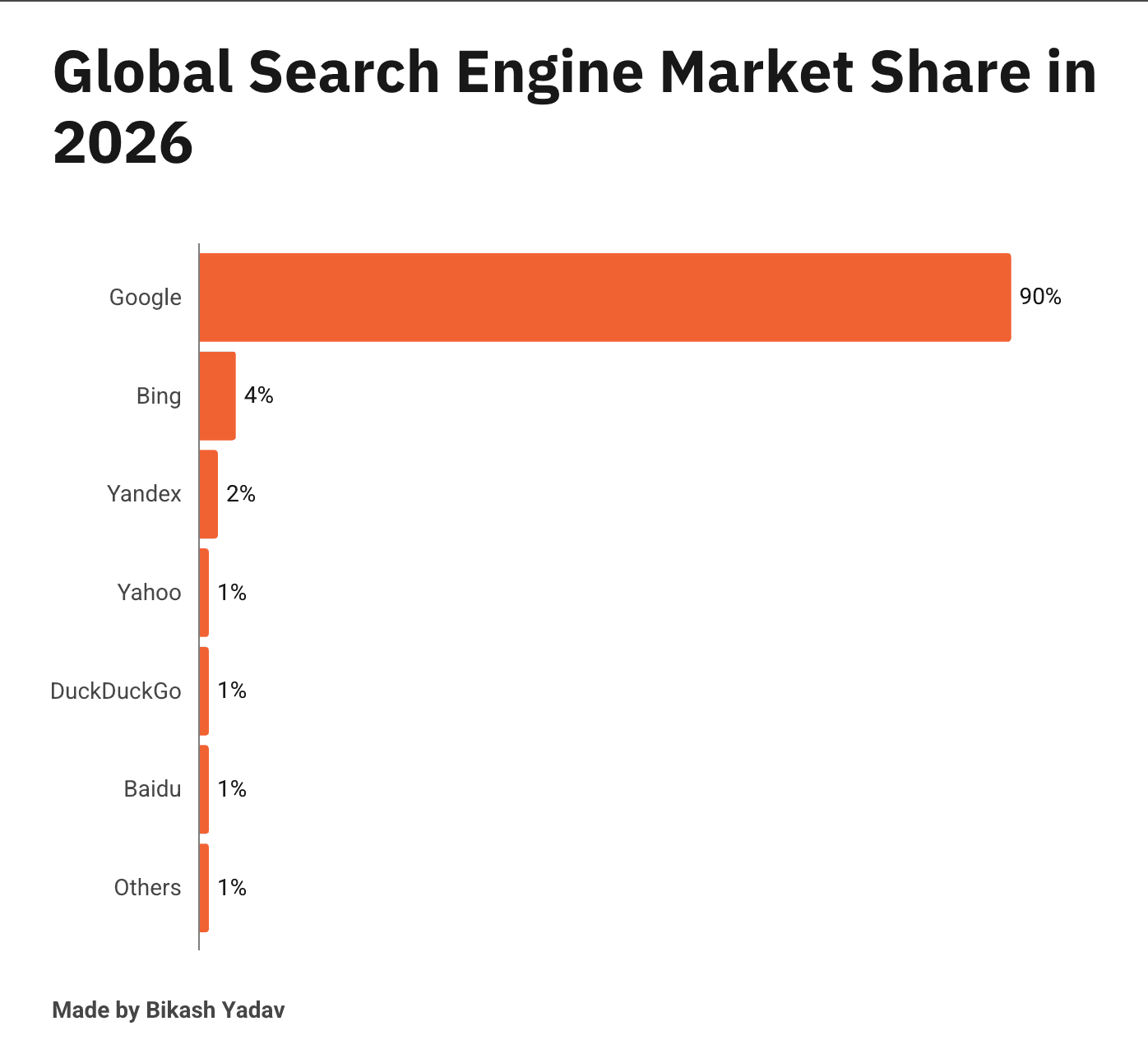
Global Search Engine Market Share in 2026
This visually reflects just how skewed the market is.
Here’s a concise predictive quote you can incorporate into reports, presentations, or strategy content:
In 2026, search remains overwhelmingly led by Google. With an estimated share of roughly 89 – 91 % of global search queries, Google continues to shape how people discover information online. Alternative platforms will retain small but stable positions, especially in regional markets, yet none are poised to seriously disrupt Google’s global dominance in the near term.
That prediction reflects current trend data from global tracking services.
These numbers aren’t just trivia; they should influence how you allocate time and resources.
Most traffic worldwide comes through Google. If your goal is organic search visibility, optimize first for Google’s ranking systems and guidelines.
Practical steps:
This aligns effort with reach.
If you serve users in countries where local engines matter (like Yandex in Russia, Baidu in China, or Naver in South Korea), adjust strategy:
You might optimize content differently for Russia than for global audiences.
Search isn’t just web pages anymore. Internal search inside platforms matters:
Use those channels to fill gaps in your audience’s journey.
Here’s a simple rule:
Decisions should follow where users actually are, not where you wish they were.
2026 search engine share still looks like this: Google dominates globally at roughly nine out of ten searches, while Bing, Yandex, Yahoo, DuckDuckGo, and regional engines split the rest. The device type and geography skew those patterns, so context matters.
Use this data to focus your SEO and content priorities where they’ll deliver real impact.